m 1 revision imported |
|||
| (25 intermediate revisions by 2 users not shown) | |||
| Line 27: | Line 27: | ||
{{#display_map: | {{#display_map: | ||
40. | 40.54384552865135, -3.7001765154669917~Train Station UAM; | ||
40.54561615096305, -3.692864323401343~El Goloso ( | 40.59861134541355, -3.715578740594877~Train Station Tres Cantos; | ||
40.601729668839276, -3.7140155088021896~Hotel; | 40.54690, -3.692399~Mᴜʟᴛɪᴘʜᴏᴛᴏɴɪᴄs 2025<br>Day 1 (Wed 8); | ||
40.54431211734461, -3.690215413275033~Cafeteria ( | 40.542875054113786, -3.688451631628911~Mᴜʟᴛɪᴘʜᴏᴛᴏɴɪᴄs 2025<br>Day 2 (Thu 9); | ||
40.54561615096305, -3.692864323401343~El Goloso (Wed 8 lunch); | |||
40.597226698748415, -3.702104114852499~[https://emeterio.com/ Casa Emeterio] (Wed 8 Dinner); | |||
40.601729668839276, -3.7140155088021896~[https://www.trescantos-hotel.com/ Hotel]; | |||
40.54431211734461, -3.690215413275033~Cafeteria (Thu 9 lunch); | |||
40.41540847521611, -3.7073765955284195~Plaza Mayor de Madrid; | 40.41540847521611, -3.7073765955284195~Plaza Mayor de Madrid; | ||
}} | }} | ||
== Transfer == | |||
From [[Madrid Barajas Airport]] to [[Tres Cantos]] is relatively simple and cheap. There are various options, including direct bus, metro, etc. The most convenient [besides taxi which comes at about ~50€, could be much less with apps] is by local train (called ''Cercanías'' in [[Spanish]]) or Metro from T4 or the Metro only from T1, T2, T3, but both involve a change at ''Nuevos Ministerios'', where you take again Cercanías line C4. There's only one line of Cercanías at T4 (C1) so no confusion possible and you can get a single ticket for the whole trip. In Nuevos Ministerios, you take line C4, direction [[Colmenar Viejo]] and stop at Tres Cantos. It should take about 45 min and less than 10€ even with mistakes. Your hotel is within walking distance. The line C4 passes by the ''Cantoblanco'' stop, which is that of the University campus. So from your hotel, you reach the campus with the same line. | |||
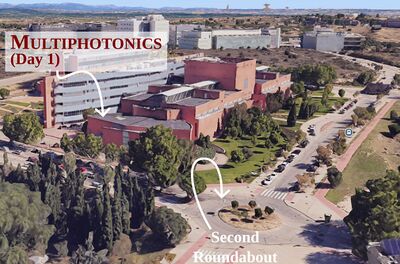
On Campus, from the station, you go down the whole ''Avenidad de Francisco Tomás y Valiente'' (named after a professor who was shot in his office on this very campus, by the ETA terrorist group), which is the most obvious route that most people take, until you find the second roundabout. This is an easy stroll with good walking paths for pedestrians. From this 2nd roundabout: | |||
# The [https://www.uam.es/eps/escuela/conocenos Escuela Politécnica Superior], which is where we celebrate the first day, is a large dark-red brick modern building right to your left, going upward. We are asked to enter directly in the Amphitheatre, which is the roundish and closest part of the building to you. Enter from the leftmost part. This is the point on the map: [https://tinyurl.com/26dpzo2v 40°32'49.0"N 3°41'32.8"W]<center><wz tip="From the second roundabout you find going in a straight line from the train station, the building for the first day of the meeting is right under your nose, left nostril.">[[File:Screenshot_20250926_195957.jpg|400px]]</wz></center> | |||
# The [https://www.csic.es/es/el-csic/organizacion/institutos-centros-y-unidades/instituto-de-ceramica-y-vidrio Instituto de Cerámica y Vidrio], which is where we celebrate the second day, is, from the same second roundabout, this time on your right, going downward, quite farther than the Politecnica but by then we will have shown you how to go. This is the point on the map: [https://tinyurl.com/25c62ncr 40°32'33.3"N 3°41'17.9"W]. | |||
To make this even simpler, we will offer [[#Car_pool|car shuttle]] for the Tres Cantos guests, at critical times of your journey (hotel-meeting, meeting-hotel, hotel-restaurant, restaurant-hotel) so you should be able to avoid all complications. If you get lost, call Elena +34 639 488 527 or Fabrice +34 644 290 781. | |||
== Hotel accommodation == | == Hotel accommodation == | ||
External attendants will be provided with a two-nights (Tue 7 & Wed 9) hotel room with breakfast at the [https://www.trescantos-hotel.com/ VP Jardín De Tres Cantos] in [[Tres Cantos]]. This is a quiet, modern urban-planning city at the north of [[Madrid]], well connected to the site of the meeting and to the Spanish capital itself. | External attendants will be provided with a two-nights (Tue 7 & Wed 9) hotel room with breakfast at the [https://www.trescantos-hotel.com/ VP Jardín De Tres Cantos] in [[Tres Cantos]]. This is a quiet, modern urban-planning city at the north of [[Madrid]], well connected to the site of the meeting and to the Spanish capital itself. | ||
== Car pool == | |||
We will organize transfer from the Tres Cantos hotel to the event locations. If you miss your car-shuttle, please refer to [[#Transfer|transfer]] instructions. We meet at 8:20 in front of your hotel. | |||
{{multicol}} | |||
<u>Car 1:</u> | |||
* With Elena: | |||
* Jesper, Kai, Vincenzo & Vladislav. | |||
<u>Car 2:</u> | |||
* With Fabrice: | |||
* Camilo, Sven, Moritz & Phillip. | |||
{{multicol-break}} | |||
<u>Car 3:</u> | |||
* With Carlos Antón: | |||
* Zhiliang, Ahsan, Jake & Sang Kyu. | |||
<u>Car 4:</u> | |||
* With Carlos Sánchez: | |||
* Natalia, Alexandros, Lukas & Yajun. | |||
{{multicol-end}} | |||
== Gastronomic Journey == | |||
[[File:Screenshot_20250922_233318.png|90px|right|link=https://emeterio.com]]There will be little time to see much of Spain out of its ''salones de actos'' but since much of the country's generosity is expressed through its food, we will make a pause at ''El Goloso Campus'' to have a taste of genuine gastronomy at the foot of amphiteatres and laboratories, and for guests staying in Tres Cantos, at the famed ''[https://emeterio.com/ Casa Emeterio]'' which provides some of the finest Castilian food in the sector. We recommend the [[Cochinillo]] (suckling piglet), a speciality of nearby [[Segovia]], or the [[Cordero lechal]] (suckling lamb), a speciality of [[Madrid's mountains]], in addition to their outstanding cooking of fresh fish. On the second day, a visit at the Cafeteria will likewise impress those having this experience for the first time, of what is probably the best canteen food in Europe. | |||
== Organizers == | == Organizers == | ||
The event is supported by a joint [[ICMM]]‒[[IFF]] effort: | The event is supported by a joint [[ICMM]]‒[[IFF]]-[[UAM]] effort: | ||
* [[Fabrice Laussy]] from [[ICMM]]‒[[CSIC]]. | * [[Fabrice Laussy]] from [[ICMM]]‒[[CSIC]]. | ||
* [[Carlos Sánchez Muñoz]] from [[IFF]]‒[[CSIC]]. | * [[Carlos Sánchez Muñoz]] from [[IFF]]‒[[CSIC]]. | ||
[mailto:fabrice.laussy@gmail.com,carlossmwolff@gmail.com?subject=MULTIPHOTONICS%20(2025)%21 Contact the organizers]. | * [[Antonio Isaac Fernandez Dominguez]] from the {{uam}}. | ||
[mailto:fabrice.laussy@gmail.com,carlossmwolff@gmail.com,a.fernandez-dominguez@uam.es?subject=MULTIPHOTONICS%20(2025)%21 Contact the organizers]. | |||
== Participants == | == Participants == | ||
{{#vardefine:speaker-font-size|1.3em}} | {{#vardefine:speaker-font-size|1.3em}} | ||
# <span style="font-size:{{#var:speaker-font-size}};">[[Serge Reynaud]]</span> <div style="display:inline-block; vertical-align:middle; position:relative; top:-0.2em; line-height:0.8em; margin-left:1em;">• <small>[[Laboratoire Kastler Brossel]], [[Paris]]</small><br>• <small><wz tip="“Quantum jumps in single-atom resonance fluorescence” on Wed 8, 9:00-9:30">[[#Serge Reynaud|Abstract]]</wz></small></div> | # <span style="font-size:{{#var:speaker-font-size}};">[[Serge Reynaud]]</span> <div style="display:inline-block; vertical-align:middle; position:relative; top:-0.2em; line-height:0.8em; margin-left:1em;">• <small>[[Laboratoire Kastler Brossel]], [[Paris]]</small><br>• <small><wz tip="“Quantum jumps in single-atom resonance fluorescence” on Wed 8, 9:00-9:30">[[#Serge Reynaud|Abstract]]</wz></small></div> | ||
# <span style="font-size:{{#var:speaker-font-size}};">[[Sven Höfling]]</span> <div style="display:inline-block; vertical-align:middle; position:relative; top:-0.2em; line-height:0.8em; margin-left:1em;">• <small>[[University of Würzburg]], [[Würzburg]]</small><br>• <small><wz tip=" | # <span style="font-size:{{#var:speaker-font-size}};">[[Sven Höfling]]</span> <div style="display:inline-block; vertical-align:middle; position:relative; top:-0.2em; line-height:0.8em; margin-left:1em;">• <small>[[University of Würzburg]], [[Würzburg]]</small><br>• <small><wz tip="“Towards photonic cluster state generation at the telecom wavelength” on Thu 9, 9:00-9:30">[[#Sven Höfling|Abstract]]</wz></small></div> | ||
# <span style="font-size:{{#var:speaker-font-size}};">[[Jesper Mørk]]</span> <div style="display:inline-block; vertical-align:middle; position:relative; top:-0.2em; line-height:0.8em; margin-left:1em;">• <small>[[Technical University of Denmark]], [[Copenhagen]]</small><br>• <small><wz tip="“Quantum noise and squeezing in nanolasers” on Wed 8, 11:30-12:00">[[#Jesper Mørk|Abstract]]</wz></small></div> | # <span style="font-size:{{#var:speaker-font-size}};">[[Jesper Mørk]]</span> <div style="display:inline-block; vertical-align:middle; position:relative; top:-0.2em; line-height:0.8em; margin-left:1em;">• <small>[[Technical University of Denmark]], [[Copenhagen]]</small><br>• <small><wz tip="“Quantum noise and squeezing in nanolasers” on Wed 8, 11:30-12:00">[[#Jesper Mørk|Abstract]]</wz></small></div> | ||
# <span style="font-size:{{#var:speaker-font-size}};">[[Zhiliang Yuan]]</span> <div style="display:inline-block; vertical-align:middle; position:relative; top:-0.2em; line-height:0.8em; margin-left:1em;">• <small>[[Academy of Quantum Information Sciences]], [[Beijing]]</small><br>• <small><wz tip="“From Two-Photon Nowhere to a Two-Photon Emitter” on Thu 9, 11: | # <span style="font-size:{{#var:speaker-font-size}};">[[Zhiliang Yuan]]</span> <div style="display:inline-block; vertical-align:middle; position:relative; top:-0.2em; line-height:0.8em; margin-left:1em;">• <small>[[Academy of Quantum Information Sciences]], [[Beijing]]</small><br>• <small><wz tip="“From Two-Photon Nowhere to a Two-Photon Emitter” on Thu 9, 11:20-11:50">[[#Zhiliang Yuan|Abstract]]</wz></small></div> | ||
# <span style="font-size:{{#var:speaker-font-size}};">[[Kai Müller]]</span> <div style="display:inline-block; vertical-align:middle; position:relative; top:-0.2em; line-height:0.8em; margin-left:1em;">• <small>[[Technische Universität München]], [[München]]</small><br>• <small><wz tip=" | # <span style="font-size:{{#var:speaker-font-size}};">[[Kai Müller]]</span> <div style="display:inline-block; vertical-align:middle; position:relative; top:-0.2em; line-height:0.8em; margin-left:1em;">• <small>[[Technische Universität München]], [[München]]</small><br>• <small><wz tip="“Suppressing multi-photon events in on-demand single photon generation” on Wed 8, 9:30-10:00">[[#Kai Müller|Abstract]]</wz></small></div> | ||
# <span style="font-size:{{#var:speaker-font-size}};">[[Tim Thomay]]</span> <div style="display:inline-block; vertical-align:middle; position:relative; top:-0.2em; line-height:0.8em; margin-left:1em;">• <small>[[University at Buffalo]], [[New York]]</small><br>• <small><wz tip="“Higher-order Fock states for sensing applications” on Thu 9, 9: | # <span style="font-size:{{#var:speaker-font-size}};">[[Tim Thomay]]</span> <div style="display:inline-block; vertical-align:middle; position:relative; top:-0.2em; line-height:0.8em; margin-left:1em;">• <small>[[University at Buffalo]], [[New York]]</small><br>• <small><wz tip="“Higher-order Fock states for sensing applications” on Thu 9, 9:30-10:00">[[#Tim Thomay|Abstract]]</wz></small></div> | ||
# <span style="font-size:{{#var:speaker-font-size}};">[[Ahsan Nazir]]</span> <div style="display:inline-block; vertical-align:middle; position:relative; top:-0.2em; line-height:0.8em; margin-left:1em;">• <small>[[University of Manchester]], [[Manchester]]</small><br>• <small><wz tip="“A Markovian approach to N-photon correlations beyond the quantum regression theorem” on Wed 8, 12:30-13:00">[[#Ahsan Nazir|Abstract]]</wz></small></div> | # <span style="font-size:{{#var:speaker-font-size}};">[[Ahsan Nazir]]</span> <div style="display:inline-block; vertical-align:middle; position:relative; top:-0.2em; line-height:0.8em; margin-left:1em;">• <small>[[University of Manchester]], [[Manchester]]</small><br>• <small><wz tip="“A Markovian approach to N-photon correlations beyond the quantum regression theorem” on Wed 8, 12:30-13:00">[[#Ahsan Nazir|Abstract]]</wz></small></div> | ||
# <span style="font-size:{{#var:speaker-font-size}};">[[Jake Iles-Smith]]</span> <div style="display:inline-block; vertical-align:middle; position:relative; top:-0.2em; line-height:0.8em; margin-left:1em;">• <small>[[University of Sheffield]], [[Sheffield]]</small><br>• <small><wz tip="“Beyond the Quantum Regression Theorem: Tensor Network Methods for Solid-State Quantum Optics” on Wed 8, 17:30-18:00">[[#Jake Iles-Smith|Abstract]]</wz></small></div> | # <span style="font-size:{{#var:speaker-font-size}};">[[Jake Iles-Smith]]</span> <div style="display:inline-block; vertical-align:middle; position:relative; top:-0.2em; line-height:0.8em; margin-left:1em;">• <small>[[University of Sheffield]], [[Sheffield]]</small><br>• <small><wz tip="“Beyond the Quantum Regression Theorem: Tensor Network Methods for Solid-State Quantum Optics” on Wed 8, 17:30-18:00">[[#Jake Iles-Smith|Abstract]]</wz></small></div> | ||
# <span style="font-size:{{#var:speaker-font-size}};">[[Philipp Schneeweiß]]</span> <div style="display:inline-block; vertical-align:middle; position:relative; top:-0.2em; line-height:0.8em; margin-left:1em;">• <small>[[Humboldt-Universität zu Berlin]], [[Berlin]]</small><br>• <small><wz tip="“Tailoring photon statistics with an atom-based two-photon interferometer” on Wed 8, 15:00-15:30">[[#Philipp Schneeweiß|Abstract]]</wz></small></div> | # <span style="font-size:{{#var:speaker-font-size}};">[[Philipp Schneeweiß]]</span> <div style="display:inline-block; vertical-align:middle; position:relative; top:-0.2em; line-height:0.8em; margin-left:1em;">• <small>[[Humboldt-Universität zu Berlin]], [[Berlin]]</small><br>• <small><wz tip="“Tailoring photon statistics with an atom-based two-photon interferometer” on Wed 8, 15:00-15:30">[[#Philipp Schneeweiß|Abstract]]</wz></small></div> | ||
# <span style="font-size:{{#var:speaker-font-size}};">[[Vincenzo D'Ambrosio]]</span> <div style="display:inline-block; vertical-align:middle; position:relative; top:-0.2em; line-height:0.8em; margin-left:1em;">• <small>[[Università di Napoli Federico II]], [[Napoli]]</small><br>• <small><wz tip="“Tailoring spatial correlations with structured light” on Thu 9, 14: | # <span style="font-size:{{#var:speaker-font-size}};">[[Vincenzo D'Ambrosio]]</span> <div style="display:inline-block; vertical-align:middle; position:relative; top:-0.2em; line-height:0.8em; margin-left:1em;">• <small>[[Università di Napoli Federico II]], [[Napoli]]</small><br>• <small><wz tip="“Tailoring spatial correlations with structured light” on Thu 9, 14:30-15:00">[[#Vincenzo D'Ambrosio|Abstract]]</wz></small></div> | ||
# <span style="font-size:{{#var:speaker-font-size}};">[[Vladislav Shishkov|Владислав Шишков (Vladislav Shishkov)]]</span> <div style="display:inline-block; vertical-align:middle; position:relative; top:-0.2em; line-height:0.8em; margin-left:1em;">• <small>[[Aalto University]], [[Espoo]]</small><br>• <small><wz tip="“Spectral theory and statistical properties of integrated single-photon sources” on Wed 8, 13:00-13:30">[[#Владислав Шишков|Abstract]]</wz></small></div> | # <span style="font-size:{{#var:speaker-font-size}};">[[Vladislav Shishkov|Владислав Шишков (Vladislav Shishkov)]]</span> <div style="display:inline-block; vertical-align:middle; position:relative; top:-0.2em; line-height:0.8em; margin-left:1em;">• <small>[[Aalto University]], [[Espoo]]</small><br>• <small><wz tip="“Spectral theory and statistical properties of integrated single-photon sources” on Wed 8, 13:00-13:30">[[#Владислав Шишков|Abstract]]</wz></small></div> | ||
# <span style="font-size:{{#var:speaker-font-size}};">[[Juan Camilo López Carreño]]</span> <div style="display:inline-block; vertical-align:middle; position:relative; top:-0.2em; line-height:0.8em; margin-left:1em;">• <small>[[University of Warsaw]], [[Warsaw]]</small><br>• <small><wz tip=" | # <span style="font-size:{{#var:speaker-font-size}};">[[Juan Camilo López Carreño]]</span> <div style="display:inline-block; vertical-align:middle; position:relative; top:-0.2em; line-height:0.8em; margin-left:1em;">• <small>[[University of Warsaw]], [[Warsaw]]</small><br>• <small><wz tip="“Pulsed Quantum Excitation” on Wed 8, 10:30-11:00">[[#Juan Camilo López Carreño|Abstract]]</wz></small></div> | ||
# <span style="font-size:{{#var:speaker-font-size}};">[[Yajun Wang|王雅君 (Yajun Wang)]]</span> <div style="display:inline-block; vertical-align:middle; position:relative; top:-0.2em; line-height:0.8em; margin-left:1em;">• <small>[[Shanxi University]], [[Taiyuan]]</small><br>• <small><wz tip="“Squeezed light and lasing” on Wed 8, 18: | # <span style="font-size:{{#var:speaker-font-size}};">[[Yajun Wang|王雅君 (Yajun Wang)]]</span> <div style="display:inline-block; vertical-align:middle; position:relative; top:-0.2em; line-height:0.8em; margin-left:1em;">• <small>[[Shanxi University]], [[Taiyuan]]</small><br>• <small><wz tip="“Squeezed light and lasing” on Wed 8, 18:00-18:30">[[#Yajun Wang (王雅君)|Abstract]]</wz></small></div> | ||
# <span style="font-size:{{#var:speaker-font-size}};">[[Alexandros Spiliotis]]</span> <div style="display:inline-block; vertical-align:middle; position:relative; top:-0.2em; line-height:0.8em; margin-left:1em;">• <small>[[IESL-FORTH]], [[Heraklion]]</small><br>• <small><wz tip=" | # <span style="font-size:{{#var:speaker-font-size}};">[[Alexandros Spiliotis]]</span> <div style="display:inline-block; vertical-align:middle; position:relative; top:-0.2em; line-height:0.8em; margin-left:1em;">• <small>[[IESL-FORTH]], [[Heraklion]]</small><br>• <small><wz tip="“Enhancing Spatial Photonic Ising Machines with quantum correlations: applications in the one- and multi-photon regimes” on Thu 9, 15:00-15:30">[[#Alexandros Spiliotis|Abstract]]</wz></small></div> | ||
# <span style="font-size:{{#var:speaker-font-size}};">[[Natalia Armaou]]</span> <div style="display:inline-block; vertical-align:middle; position:relative; top:-0.2em; line-height:0.8em; margin-left:1em;">• <small>[[Westlake University]], [[Hangzhou]]</small><br>• <small><wz tip="“Spatial correlations of opposite OAM states of light” on Thu 9, 15: | # <span style="font-size:{{#var:speaker-font-size}};">[[Natalia Armaou]]</span> <div style="display:inline-block; vertical-align:middle; position:relative; top:-0.2em; line-height:0.8em; margin-left:1em;">• <small>[[Westlake University]], [[Hangzhou]]</small><br>• <small><wz tip="“Spatial correlations of opposite OAM states of light” on Thu 9, 15:30-15:50">[[#Natalia Armaou|Abstract]]</wz></small></div> | ||
# <span style="font-size:{{#var:speaker-font-size}};">[[ | # <span style="font-size:{{#var:speaker-font-size}};">[[Carlos Antón Solanas]]</span> <div style="display:inline-block; vertical-align:middle; position:relative; top:-0.2em; line-height:0.8em; margin-left:1em;">• <small>{{uam}}</small><br>• <small><wz tip="“Superposition and entanglement with vacuum-one-photon states” on Thu 9, 11:50-12:20">[[#Carlos Antón Solanas|Abstract]]</wz></small></div> | ||
# <span style="font-size:{{#var:speaker-font-size}};">[[ | # <span style="font-size:{{#var:speaker-font-size}};">[[Johannes Feist]]</span> <div style="display:inline-block; vertical-align:middle; position:relative; top:-0.2em; line-height:0.8em; margin-left:1em;">• <small>{{uam}}</small><br>• <small><wz tip="“Fully differential photon statistics in complex nanophotonic systems” on Wed 8, 15:30-16:00">[[#Johannes Feist|Abstract]]</wz></small></div> | ||
# <span style="font-size:{{#var:speaker-font-size}};">[[ | # <span style="font-size:{{#var:speaker-font-size}};">[[Antonio Isaac Fernandez Dominguez]]</span> <div style="display:inline-block; vertical-align:middle; position:relative; top:-0.2em; line-height:0.8em; margin-left:1em;">• <small>{{uam}}</small><br>• <small><wz tip="“Preparation of quantum emitter states with nanophotonics tools” on Thu 9, 10:00-10:30">[[#Antonio Isaac Fernandez Dominguez|Abstract]]</wz></small></div> | ||
# <span style="font-size:{{#var:speaker-font-size}};">[[ | # <span style="font-size:{{#var:speaker-font-size}};">[[Alejandro González Tudela]]</span> <div style="display:inline-block; vertical-align:middle; position:relative; top:-0.2em; line-height:0.8em; margin-left:1em;">• <small>[[IFF]]-[[CSIC]], [[Madrid]]</small><br>• <small><wz tip="“Controlling propagating photons with chiral, multi-mode waveguide QED” on Thu 9, 12:40-13:10">[[#Alejandro González Tudela|Abstract]]</wz></small></div> | ||
# <span style="font-size:{{#var:speaker-font-size}};">[[ | # <span style="font-size:{{#var:speaker-font-size}};">[[Eduardo Zubizarreta Casalengua]]</span> <div style="display:inline-block; vertical-align:middle; position:relative; top:-0.2em; line-height:0.8em; margin-left:1em;">• <small>[[Technische Universität München]], [[München]]</small><br>• <small><wz tip="“Steering photons through energy and time” on Thu 9, 10:30-11:00">[[#Eduardo Zubizarreta Casalengua|Abstract]]</wz></small></div> | ||
# <span style="font-size:{{#var:speaker-font-size}};">[[ | # <span style="font-size:{{#var:speaker-font-size}};">[[Sang Kyu Kim]]</span> <div style="display:inline-block; vertical-align:middle; position:relative; top:-0.2em; line-height:0.8em; margin-left:1em;">• <small>[[Technische Universität München]], [[München]]</small><br>• <small><wz tip="“Deterministic control of photon-number probabilities via phase-controlled quantum interference” on Thu 9, 12:20-12:40">[[#Sang Kyu Kim|Abstract]]</wz></small></div> | ||
# <span style="font-size:{{#var:speaker-font-size}};">[[ | # <span style="font-size:{{#var:speaker-font-size}};">[[Joaquin Guimbao Gaspar]]</span> <div style="display:inline-block; vertical-align:middle; position:relative; top:-0.2em; line-height:0.8em; margin-left:1em;">• <small>[[ICMM]]-[[CSIC]], [[Madrid]]</small><br>• <small><wz tip="“Multiphoton correlations from spatially extended quantum states” on Wed 8, 10:00-10:30">[[#Joaquin Guimbao Gaspar|Abstract]]</wz></small></div> | ||
# <span style="font-size:{{#var:speaker-font-size}};">[[ | # <span style="font-size:{{#var:speaker-font-size}};">[[Jacob Ngaha]]</span> <div style="display:inline-block; vertical-align:middle; position:relative; top:-0.2em; line-height:0.8em; margin-left:1em;">• <small>[[ICMM]]-[[CSIC]], [[Madrid]]</small><br>• <small><wz tip="“Frequency-Filtered Photon Correlations of a Three-Level Ladder-Type Atom” on Wed 8, 16:30-17:00">[[#Jacob Ngaha|Abstract]]</wz></small></div> | ||
# <span style="font-size:{{#var:speaker-font-size}};">[[ | # <span style="font-size:{{#var:speaker-font-size}};">[[Lukas Hanschke]]</span> <div style="display:inline-block; vertical-align:middle; position:relative; top:-0.2em; line-height:0.8em; margin-left:1em;">• <small>[[Technische Universität München]], [[München]]</small><br>• <small><wz tip="“Unlocking multiphoton emission from a single-photon source through mean-field engineering” on Wed 8, 16:00-16:30">[[#Lukas Hanschke|Abstract]]</wz></small></div> | ||
# <span style="font-size:{{#var:speaker-font-size}};">[[ | # <span style="font-size:{{#var:speaker-font-size}};">[[Elena del Valle]]</span> <div style="display:inline-block; vertical-align:middle; position:relative; top:-0.2em; line-height:0.8em; margin-left:1em;">• <small>{{uam}}</small><br>• <small><wz tip="“The true colors of quantum light” on Wed 8, 12:00-12:30">[[#Elena del Valle|Abstract]]</wz></small></div> | ||
# <span style="font-size:{{#var:speaker-font-size}};">[[ | # <span style="font-size:{{#var:speaker-font-size}};">[[Carlos Sánchez]]</span> <div style="display:inline-block; vertical-align:middle; position:relative; top:-0.2em; line-height:0.8em; margin-left:1em;">• <small>[[IFF]]-[[CSIC]], [[Madrid]]</small><br>• <small><wz tip="“Quantum metrology through spectral measurements in quantum optics” on Wed 8, 18:30-19:00">[[#Carlos Sánchez|Abstract]]</wz></small><small> 🙵 <wz tip="“Closing” on Thu 9, 16:20-16:30">[[#Closing_(by_Carlos_Sánchez)|Closing]]</wz></small></div> | ||
# <span style="font-size:{{#var:speaker-font-size}};">[[Fabrice Laussy]]</span> <div style="display:inline-block; vertical-align:middle; position:relative; top:-0.2em; line-height:0.8em; margin-left:1em;">• <small>[[ICMM]]-[[CSIC]], [[Madrid]]</small><br>• <small><wz tip="“Welcome to Spain and to MULTIPH🟕TONICS 2025” on Wed 8, 8:50-9:00">[[#Opening_(by_Fabrice_Laussy)|Opening]]</wz> 🙵 <wz tip="“Liquid time and time liquids” on Thu 9, 15:50-16:20">[[#Fabrice Laussy|Abstract]]</wz></small></div> | |||
<!--# <span style="font-size:{{#var:speaker-font-size}};">[[Fabrice Laussy]]</span> <div style="display:inline-block; vertical-align:middle; position:relative; top:-0.2em; line-height:0.8em; margin-left:1em;">• <small>[[ICMM]]-[[CSIC]], [[Madrid]]</small><br></div> | |||
<!--# [[Serge Reynaud]]<wz tip="Prof. Reynaud will also give an INC Colloquium on Friday 10 on the topic of Casimir forces."><sup>*</sup></wz> - [[Laboratoire Kastler Brossel]], [[Paris]] | <!--# [[Serge Reynaud]]<wz tip="Prof. Reynaud will also give an INC Colloquium on Friday 10 on the topic of Casimir forces."><sup>*</sup></wz> - [[Laboratoire Kastler Brossel]], [[Paris]] | ||
# [[Sven Höfling]] - [[University of Würzburg]], [[Würzburg]] | # [[Sven Höfling]] - [[University of Würzburg]], [[Würzburg]] | ||
| Line 104: | Line 146: | ||
# [[Fabrice Laussy]] - [[ICMM]]-[[CSIC]], [[Madrid]]--> | # [[Fabrice Laussy]] - [[ICMM]]-[[CSIC]], [[Madrid]]--> | ||
== | == Program == | ||
=== Tuesday 7 October === | === Tuesday 7 October === | ||
| Line 115: | Line 157: | ||
===== Opening (by Fabrice Laussy) ===== | ===== Opening (by Fabrice Laussy) ===== | ||
8:50-9:00 | ''Welcome to Spain and to ''<font color=#8B0000>M<small>ULTI</font><font color=#0000BC>PH🟕TONICS</font></small>'' 2025'' — 8:50-9:00 | ||
===== Serge Reynaud ===== | ===== Serge Reynaud ===== | ||
| Line 123: | Line 165: | ||
===== Kai Müller ===== | ===== Kai Müller ===== | ||
'' | ''Suppressing multi-photon events in on-demand single photon generation'' — 9:30-10:00 | ||
: | :For the on-demand generation of single photons, few-level quantum systems are typically excited with short optical pulses. However, the purity of single-photon generation is limited by the unwanted emission of multi-photon states. This occurs due to the emission of the system during the presence of the excitation pulse which can lead to re-excitation and subsequent emission of another photon with non-vanishing probability. In this talk, I will discuss the dynamics of this process,{{cite|fischer17b}} and how detrimental effects of multi-photon emission can be suppressed by tailored excitation schemes{{cite|hanschke18a}}{{cite|sbresny22a}} or/and frequency filtering of the emission.{{cite|arXiv_sbresny25a}} | ||
===== Joaquin Guimbao Gaspar ===== | ===== Joaquin Guimbao Gaspar ===== | ||
10:00-10:30 | ''Multiphoton correlations from spatially extended quantum states'' — 10:00-10:30 | ||
:The distribution of bosons in space, in one form or another, has supported some of the most important developments of modern physics. Here, I will review the particular but intriguing case of distributing two bosons in the special topology of vortices{{cite|arXiv_casalengua24a}} and show that when going to the high multiphoton case—where single-shot experiments become sufficient to acquire enough data to construct observables—in arbitrary geometries, one encounters a series of fundamental questions that can be revisited and experimentally implemented from, including: | |||
:# the equivalence (or lack-of) between quantum and statistical averages. | |||
:# the problem of quantum supremacy formulated as a boson distribution problem. | |||
:# the problem of symmetry breaking from quantum measurement. | |||
:# the emergence of fractal behaviour from a linear system. | |||
:# the prospects for computational resources by spatial-wavefront engineering. | |||
===== Juan Camilo López Carreño ===== | ===== Juan Camilo López Carreño ===== | ||
10:30-11:00 | ''Pulsed Quantum Excitation'' — 10:30-11:00 | ||
:The interaction between a single atom and a single photon is at the heart of Quantum Optics. At its most fundamental level, such an interaction can be modelled as the optical excitation of a two-level system. Its response to classical light is well known, as it converts pulses of coherent light into antibunched emission. Although recent theoretical proposals have predicted that it is advantageous to illuminate two-level systems with quantum light—i.e., the light emitted by a quantum system—those proposals were made in the regime of continuous excitation.{{cite|lopezcarreno16b}}{{cite|lopezcarreno18b}} | |||
:Here, we consider a laser pulse driving a two-level system. Then, we collect the emission from the latter to excite an identical two-level system; this time with quantum light. Thus, an analysis of the one- and two-photon observables of these two emitters reveals the advantages of using quantum rather than classical excitation. Firstly, the emission spectrum of the two-level system driven with quantum pulses is narrower than its natural linewidth. Secondly, the light emitted from the two-level system with quantum excitation is more antibunched and more indistinguishable than its counterpart with classical excitation.{{cite|arXiv_lopezcarreno24a}} | |||
:Our results reinforce the claim of the advantage of excitation with quantum light, provide support for the recent experimental observation of such an excitation,{{cite|arXiv_hansen24a}} and can be used as a roadmap for the future of light-matter interaction research and to improve the quality of state-of-the-art sources of single photons.{{cite|somaschi16a}}{{cite|tomm21a}} | |||
'''''Coffee break''''' | '''''Coffee break''''' | ||
==== Post-coffee <!-- Sven-->==== | ==== Post-coffee <!-- Sven-->==== | ||
| Line 141: | Line 197: | ||
===== Elena del Valle ===== | ===== Elena del Valle ===== | ||
12:00-12:30 | ''The true colors of quantum light'' — 12:00-12:30 | ||
:Correlations between photons are what quantum optics is mainly about. But what is a photon? If we define this as a click on a detector, infrequent clicks at frequencies far from where many clicks are recorded count as photons too. In a classical picture, this description is less clear: the tail of a Lorentzian spectrum seems to be something else or insignificant as compared to the main peak. Quantum opticians have remained oblivious to this simple fact until our theory of frequency-resolved multiphoton correlations{{cite|delvalle12a}} allowed us to compute correlations between any two photons of any frequencies (any colors).{{cite|delvalle13a}} We discovered that even the simplest problem of resonance fluorescence{{cite|reynaud83a}}{{cite|mollow69a}} unravelled unsuspected rich structures in landscapes of correlations, independent from the spectral structure and thus of where the emission is bright.{{cite|gonzaleztudela13a}} The most obvious ones are straight lines of photon bunching, and correspond to what we called ''leapfrog transitions''. These are a variation and a generalization of Goeppert-Mayer's ''Doppelemission''. The neatest argument that such features, although invisible in the classical (one-photon) observables, are genuine, is that if you Purcell-enhance them, you make a new device.{{cite|sanchezmunoz14a}} There are other features, such as circles of antibunching (which make the logo of this meeting). It took us another decade to find what the underlying mechanism was in this case, that we recently understood as a virtual-multiphoton counterpart of quantum-field interferences.{{cite|zubizarretacasalengua20a}} Those not only look like circular, they are perfect circles due to phase-matching of two-photon squeezing with the coherent mean field of the emission.{{cite|zubizarretacasalengua24b}} There remains much to prospect and understand, especially at the $n\ge3$-photon level. Still, to this day, most quantum opticians remain oblivious of these facts even for two photons, and of the hidden scenery that lays dormant behind the classical picture (there are exceptions{{cite|peiris15a}}). As such, they only see the classical peaks that hide the multiphoton forest. In this talk, I will try to paint a more faithful picture of quantum light, using its true colors.{{cite|mukamel20a}} | |||
===== Ahsan Nazir ===== | ===== Ahsan Nazir ===== | ||
| Line 162: | Line 220: | ||
''Tailoring photon statistics with an atom-based two-photon interferometer'' — 15:00-15:30 | ''Tailoring photon statistics with an atom-based two-photon interferometer'' — 15:00-15:30 | ||
:Controlling the photon statistics of light is paramount for quantum science and technologies. Recently, we demonstrated that transmitting resonant laser light past an ensemble of two-level emitters can result in a stream of single photons or excess photon pairs. This transformation is due to quantum interference between the transmitted laser light and the incoherently scattered photon pairs.{{cite|prasad20a}} Here, using the dispersion of the atomic medium, we actively control the relative quantum phase between these two components. We thereby realize a tunable two-photon interferometer and observe interference fringes in the normalized photon coincidence rate. When tuning the relative phase, the coincidence rate varies periodically, giving rise to a continuous modification of the photon statistics from antibunching to bunching. Beyond the fundamental insight that there exists a tunable quantum phase between incoherent and coherent light that dictates the photon statistics, our results lend themselves to the development of novel quantum light sources.{{cite|cordier23a}} | |||
===== Johannes Feist ===== | ===== Johannes Feist ===== | ||
15:30-16:00 | ''Fully differential photon statistics in complex nanophotonic systems'' — 15:30-16:00 | ||
:I will discuss our approach to obtain a quantum-optics like description in terms of a few discrete modes for the quantum light-matter interaction in arbitrary nanophotonic structures, while still taking into account the full nanophotonic complexity of light propagation and emission.{{cite|medina21a}}{{cite|sanchezbarquilla22a}} I will then discuss how applying the idea of the sensor method{{cite|delvalle12a}} by placing the sensor emitters in space gives direct access to photon correlations of the emitted light resolved in space, frequency, time and polarization for arbitrary electromagnetic environments, while correctly accounting for fully retarded light propagation to the detectors.{{cite|lednev25a}} Finally, I will discuss some fundamental properties of light-matter interactions and show that single-emitter ultrastrong coupling can in fact not be reached with photons (quanta of the transverse electromagnetic field).{{cite|arXiv_delapradilla25a}} | |||
===== Lukas Hanschke ===== | ===== Lukas Hanschke ===== | ||
16:00-16:30 | ''Unlocking multiphoton emission from a single-photon source through mean-field engineering'' — 16:00-16:30 | ||
:Multiphotons are generally regarded as accidental in the context of single photon sources. However, multiphoton emission can turn out to be even more fundamental and interesting than the single-photon emission, since in a coherently driven system, the multiphoton suppression arises from quantum interferences between virtual multiphoton fluctuations and the mean field in a Poisson superposition of all number states. Here, we demonstrate how one can control the multiphoton dynamics of a two-level system by disrupting these quantum interferences through a precise and independent homodyne control of the mean field. We show that, counterintuitively, quantum fluctuations always play a major qualitative role, even and in fact especially, when their quantitative contribution is vanishing as compared to that of the mean field.{{cite|arXiv_kim24a}} | |||
===== Jacob Ngaha ===== | ===== Jacob Ngaha ===== | ||
16:30-17:00 | ''Frequency-Filtered Photon Correlations of a Three-Level Ladder-Type Atom'' — 16:30-17:00 | ||
:Resonance fluorescence of a two-level atom is one of the simplest examples of light interacting with matter, yet it is a key concept in quantum optics. Upon strong coherent excitation, the fluorescence spectrum splits into three components known as the Mollow triplet. This splitting is a due to transitions amongst the atom’s “dressed states”; a direct result of the interaction of the atom with a strong quantised electromagnetic field. Interest in the quantum nature of the emitted light grew, particularly in the photon correlations of the two-level atom. It did not take long, however, for some to become interested in measuring photon correlations of the separate components of the Mollow triplet, by way of frequency filtering. | |||
:In this talk, we move slightly beyond the two-level atom and explore the fluorescence spectrum of a three-level ladder-type atom.{{cite|arXiv_ngaha25a}} With an increased number of atomic levels comes an increased complexity in the dressed state picture, resulting in a fluorescence spectrum which comprises of up to seven distinct peaks. We investigate the dressed-state picture of this three-level atom, by studying the photon correlations of the different peaks of the fluorescence spectrum. We do this by filtering the spectrum with the multi-mode array filter model:{{cite|ngaha24a}} a cavity based frequency filter that has an approximate box-shaped frequency response, and comparing the filtered correlations with a stand Lorentzian filter. | |||
'''''Coffee break''''' | '''''Coffee break''''' | ||
| Line 182: | Line 248: | ||
:In this talk, I will introduce a new family of methods for computing multi-time correlation functions of quantum emitters beyond atomic systems. By combining the process tensor formalism with tensor networks, these techniques provide a numerically exact framework for extracting the emission characteristics of solid-state emitters. I will illustrate their use in quantifying how electron–phonon interactions shape optical coherence, considering both localized and bulk phonon modes. Finally, I will show how these tools can be applied to place rigorous bounds on the indistinguishability and efficiency of quantum emitters in low-dimensional materials, including quantum dots in transition metal dichalcogenides (e.g. WSe₂) and atomic defects in hexagonal boron nitride. | :In this talk, I will introduce a new family of methods for computing multi-time correlation functions of quantum emitters beyond atomic systems. By combining the process tensor formalism with tensor networks, these techniques provide a numerically exact framework for extracting the emission characteristics of solid-state emitters. I will illustrate their use in quantifying how electron–phonon interactions shape optical coherence, considering both localized and bulk phonon modes. Finally, I will show how these tools can be applied to place rigorous bounds on the indistinguishability and efficiency of quantum emitters in low-dimensional materials, including quantum dots in transition metal dichalcogenides (e.g. WSe₂) and atomic defects in hexagonal boron nitride. | ||
===== Yajun Wang (王雅君) ===== | ===== Yajun Wang (王雅君) ===== | ||
''Squeezed light and lasing'' — 18: | ''Squeezed light and lasing'' — 18:00-18:30 | ||
:We focused on the study of technical and quantum noises of a laser source in interferometry. Recently, we have solved the key scientific and technical problems of laser noise characterization and stabilization beyond the quantum noise limit, explored the physical root of noise sources, and developed the key technologies of laser technical and quantum noises stabilization | :We focused on the study of technical and quantum noises of a laser source in interferometry. Recently, we have solved the key scientific and technical problems of laser noise characterization and stabilization beyond the quantum noise limit, explored the physical root of noise sources, and developed the key technologies of laser technical and quantum noises stabilization.{{cite|arXiv_li25a}}{{cite|arXiv_li25b}} Especially, we have experimentally stimulated a squeezed lasing in the reservoir-engineered optical parametric oscillator (OPO).{{cite|tian25a}} It successfully circumvents the decoherence in the system, and eliminates the undesired noise of spontaneous photon emission in the OPO. As a result, the amplified parametric process simultaneously reserves the coherence and quantum properties in the OPO, and yields a -6.1 dB squeezed laser in optical domain with a 15 kHz linewidth and 2.6 mW optical power. | ||
{{ | |||
<dl><dd> | <dl><dd> | ||
<div class="mw-collapsible mw-collapsed" data-expandtext="Show Figure" data-collapsetext="Hide"> | <div class="mw-collapsible mw-collapsed" data-expandtext="Show Figure" data-collapsetext="Hide"> | ||
| Line 202: | Line 261: | ||
===== Carlos Sánchez ===== | ===== Carlos Sánchez ===== | ||
''Quantum metrology through spectral measurements in quantum optics'' — | ''Quantum metrology through spectral measurements in quantum optics'' — 18:30-19:00 | ||
: A central challenge in quantum metrology from open quantum optical systems is to identify measurement strategies that optimally extract information encoded in the complex quantum state of emitted radiation. Different measurement strategies effectively access distinct temporal modes of the emitted field, and the resulting choice of mode can strongly impact the information available for parameter estimation. While a ubiquitous approach in quantum optics is to select frequency modes through spectral filtering, the metrological potential of this technique has not yet been systematically quantified. We develop a theoretical framework to assess this potential by modeling spectral detection as a cascaded quantum system, allowing us to reconstruct the full density matrix of frequency-filtered photonic modes and to compute their associated Fisher information. We show how this approach allows us to identify optimal filtering strategies for metrology, in terms of frequency selection, detector linewidth, and metrological gain accessible through multiphoton frequency-resolved correlations and mean-field engineering. | : A central challenge in quantum metrology from open quantum optical systems is to identify measurement strategies that optimally extract information encoded in the complex quantum state of emitted radiation. Different measurement strategies effectively access distinct temporal modes of the emitted field, and the resulting choice of mode can strongly impact the information available for parameter estimation. While a ubiquitous approach in quantum optics is to select frequency modes through spectral filtering, the metrological potential of this technique has not yet been systematically quantified. We develop a theoretical framework to assess this potential by modeling spectral detection as a cascaded quantum system, allowing us to reconstruct the full density matrix of frequency-filtered photonic modes and to compute their associated Fisher information. We show how this approach allows us to identify optimal filtering strategies for metrology, in terms of frequency selection, detector linewidth, and metrological gain accessible through multiphoton frequency-resolved correlations and mean-field engineering. | ||
| Line 213: | Line 272: | ||
===== Sven Höfling ===== | ===== Sven Höfling ===== | ||
9:00-9:30 | ''Towards photonic cluster state generation at the telecom wavelength'' — 9:00-9:30 | ||
:In recent years, it has been demonstrated that semiconductor quantum dots can act as deterministic sources of quantum light. An advanced demonstration is the generation of polarization-entangled photonic cluster states, a useful resource for quantum computing.{{cite|schwartz16a}}{{cite|cogan23a}} While this demonstration used an emission wavelength in the 900 nm range, many practical applications require a longer wavelength. For example, applications that involve silicon photonic quantum integrated circuits or optical fibers to minimize losses. For both, the wavelength of 1550 nm is well suitable. | |||
:In this talk, I will present our recent progress towards demonstrating a cluster state generation protocol using telecom-emitting quantum dots. In particular, we use an InAs/InAlGaAs quantum dot incorporated in a circular Bragg grating (‘Bullseye’) microcavity. We will present spin initialization and readout experiments based on a confined hole, and describe the pulse sequence needed to implement cluster state generation. Finally, we will share recent three-photon correlation results on the path to obtaining a full tomography of the process. | |||
===== Tim Thomay ===== | ===== Tim Thomay ===== | ||
''Higher-order Fock states for sensing applications.'' — 9: | ''Higher-order Fock states for sensing applications.'' — 9:30-10:00 | ||
:Quantum light offers groundbreaking opportunities in communication, computing, and sensing, forming the foundation of the emerging “Quantum Internet.” Most current applications rely on single photons and quantum entanglement to achieve quantum advantage. However, going beyond the single-photon regime, higher-order Fock states open entirely new avenues for quantum metrology, enhanced sensing protocols, and scalable quantum networks. A central challenge is their efficient detection, which is strongly affected by photon losses and imperfect measurement devices. | |||
:This presentation will first introduce the key distinctions between single-photon quantum light and the unique properties of higher-order Fock states. I will then discuss approaches for generating such states from solid-state nanostructures and their integration into optical fibers for scalable, fiber-based quantum devices. Additionally, I will highlight our recent work applying machine learning techniques to optimize the detection of higher-order Fock states, showing how data-driven strategies can mitigate losses and noise. Finally, I will provide examples of how multiphoton states can unlock practical applications in quantum computing, precision sensing, and fundamental physics.{{cite|powers25a}} | |||
===== Antonio Isaac Fernandez Dominguez ===== | |||
''Preparation of quantum emitter states with nanophotonics tools'' — 10:00-10:30 | |||
:In this talk, I will discuss different nanophotonics-based strategies to generate tailored states of quantum emitters. First, I will explore the creation of highly entangled multiqubit states by inverse engineering of their photonic environment.{{cite|migueltorcal22a}}{{cite|migueltorcal24a}} Next, I will address the preparation of topologically protected excitonic states in emitter chains that emulate a Su–Schrieffer–Heeger Hamiltonian (to appear in ACS Photonics). Finally, I will briefly examine the spatial dependence of photon correlations in pairs of quantum emitters placed near elementary nanophotonic structures, highlighting the conditions under which their suppression becomes independent of the internal state of the emitters themselve.{{cite|duraazorin25a}} | |||
===== Eduardo Zubizarreta Casalengua ===== | ===== Eduardo Zubizarreta Casalengua ===== | ||
10: | ''Steering photons through energy and time'' — 10:30-11:00 | ||
:Frequency (energy) and time-resolved photon correlations are nowadays a well-established tool in quantum optics.{{cite|delvalle12a}} Nonetheless, for time-dependent situations, special emphasis must be placed on the role of time detection. For this purpose, we propose an efficient method to compute frequency-filtered and time-bin-integrated photon correlations, and then we link them to the photon-counting probabilities.{{cite|arXiv_feijoo25a}} We show that photon statistics of pulsed Resonance Fluorescence emission can range from bunching to antibunching, depending on the photon frequencies and the pulse area. Then, we highlight the potential of time binning on photonic quantum states using linear optics elements and a periodic structure of less-than-one-photon pulses. In a Mach-Zehnder interferometer setup, we demonstrate how to generate few-photon states deterministically{{cite|arXiv_kim25a}} and create temporal and spatial (modes) entanglement from this photon crystal. By adequately selecting the relevant frequencies and time windows, one could potentially select the number of photons in different time bins that lead to the desired entanglement of the state. | |||
'''''Coffee break''''' | '''''Coffee break''''' | ||
==== Post-Coffee Session <!-- Elena-->==== | ==== Post-Coffee Session <!-- Elena-->==== | ||
===== Zhiliang Yuan ===== | ===== Zhiliang Yuan ===== | ||
''From Two-Photon Nowhere to a Two-Photon Emitter'' — 11: | ''From Two-Photon Nowhere to a Two-Photon Emitter'' — 11:20-11:50 | ||
:In a coherently driven two-level system, simultaneous two-photon emission is forbidden, yet strong two-photon correlations can still arise via quantum interference, as described by the pure- state model of resonance fluorescence and experimentally confirmed.{{cite|wang25c}} | :In a coherently driven two-level system, simultaneous two-photon emission is forbidden, yet strong two-photon correlations can still arise via quantum interference, as described by the pure-state model of resonance fluorescence and experimentally confirmed.{{cite|wang25c}}{{cite|arXiv_huang25a}} However, the achievable brightness in this regime is fundamentally limited. Motivated by this constraint, we demonstrate a natural two-photon emitter using a semiconductor quantum dot with degenerate biexciton–exciton transitions embedded in a Purcell-enhanced micropillar cavity. By exploiting dark-state biexciton loading and leveraging single-photon stimulated emission, we achieve a record two-photon fraction of 98.3%, marking a significant advance toward on-demand, solid- state multiphoton quantum light sources. | ||
===== Carlos Antón Solanas ===== | ===== Carlos Antón Solanas ===== | ||
''Superposition and entanglement with vacuum-one-photon states'' — 11: | ''Superposition and entanglement with vacuum-one-photon states'' — 11:50-12:20 | ||
:A two-level system (such as a charged semiconductor quantum dot), excited under a pulsed resonant drive of area $\theta$, emits photon-number superposition states composed by vacuum and a single-photon in the form $\cos(\theta/2)\ket{0}+\sin(\theta/2)\ket{1}$.{{cite|loredo19a}}{{cite|karli24a}} Additionally, a sequential two-pulse excitation can generate photon-number encoded time-entangled states of the form ${1\over\sqrt2}(\ket{0_e0_l}+\ket{1_e1_l})$ or ${1\over\sqrt2}(\ket{1_e0_l}+\ket{0_e1_l})$, where the subindex ''e'' and ''l'' refer to early and late time-bins, respectively.{{cite|wein22a}}{{cite|alvarez22a}} The expansion of this sequential excitation to a three-level system (such as one polarisation cascade of the biexciton-exciton decay) generates entanglement in time and energy,{{cite|vajner25a}} with prospects to allow secure quantum communication protocols.{{cite|santos23a}} | :A two-level system (such as a charged semiconductor quantum dot), excited under a pulsed resonant drive of area $\theta$, emits photon-number superposition states composed by vacuum and a single-photon in the form $\cos(\theta/2)\ket{0}+\sin(\theta/2)\ket{1}$.{{cite|loredo19a}}{{cite|karli24a}} Additionally, a sequential two-pulse excitation can generate photon-number encoded time-entangled states of the form ${1\over\sqrt2}(\ket{0_e0_l}+\ket{1_e1_l})$ or ${1\over\sqrt2}(\ket{1_e0_l}+\ket{0_e1_l})$, where the subindex ''e'' and ''l'' refer to early and late time-bins, respectively.{{cite|wein22a}}{{cite|alvarez22a}} The expansion of this sequential excitation to a three-level system (such as one polarisation cascade of the biexciton-exciton decay) generates entanglement in time and energy,{{cite|vajner25a}} with prospects to allow secure quantum communication protocols.{{cite|santos23a}} | ||
| Line 243: | Line 314: | ||
===== Sang Kyu Kim {{phdcandidate}} ===== | ===== Sang Kyu Kim {{phdcandidate}} ===== | ||
12: | ''Deterministic control of photon-number probabilities via phase-controlled quantum interference'' — 12:20-12:40 | ||
:Deterministically tailoring optical Fock states beyond the single-photon level is crucial for boson sampling, loss-tolerant photonic qubits, and quantum-enhanced sensing, however has yet remained elusive. Here, we present a linear-optics protocol that converts a resonantly driven single-photon emitter into a deterministic generator of few-photon states.{{cite|arXiv_kim25a}} Specifically, a phase-stabilized, path-unbalanced Mach-Zehnder interferometer combines vacuum—single-photon interference and Hong-Ou-Mandel effect. By tuning the control knobs, we observe a dynamic transition from antibunching to strong bunching in correlation measurements, shaping photon-number probabilities. With two indistinguishable emitters, this framework could be extended to generate deterministic NOON states and to filter single photons. | |||
===== Alejandro González Tudela ===== | ===== Alejandro González Tudela ===== | ||
''Controlling propagating photons with chiral, multi-mode waveguide QED | ''Controlling propagating photons with chiral, multi-mode waveguide QED | ||
'' — 12: | '' — 12:40-13:10 | ||
:Controlling propagating quantum states of light is essential for the development of photonic quantum technologies. In this talk, I will first review how qualitatively new photon-mediated interactions emerge when emitters or resonators couple to chiral, multi-mode waveguides. | :Controlling propagating quantum states of light is essential for the development of photonic quantum technologies. In this talk, I will first review how qualitatively new photon-mediated interactions emerge when emitters or resonators couple to chiral, multi-mode waveguides.{{cite|arXiv_vega24a}} I will then show how these interactions enable the implementation of controlled photon-photon phase gates using only two-level systems.{{cite|levyyeyati25a}} In both cases, I will discuss potential implementations in the microwave using circuit QED setups. | ||
'''''Lunch''''' | '''''Lunch''''' | ||
| Line 256: | Line 329: | ||
===== Vincenzo D'Ambrosio ===== | ===== Vincenzo D'Ambrosio ===== | ||
''Tailoring spatial correlations with structured light'' — 14:00- | ''Tailoring spatial correlations with structured light'' — 14:30-15:00 | ||
:Photon correlations represent a central resource in quantum optics, with applications ranging from quantum information protocols to sensing. Engineering such correlations is often challenging, especially in multi-particle scenarios. Structured light forms another hallmark of photonics, achieved by manipulating the degrees of freedom of light, and enables a multitude of applications in both classical and quantum regimes. Here, we combine these concepts and demonstrate a simple and robust scheme to tailor photon correlations directly in the transverse plane. The method relies on locally tuning the distinguishability of photon pairs through spatially structured polarization in a quantum interference setup.{{cite|schiano24a}}{{cite|arXiv_schiano25a}} Our approach offers an easy extension to multiphoton regimes and provides opportunities for high-dimensional quantum information transfer, with potential applications in quantum communication and imaging. | |||
===== Alexandros Spiliotis ===== | ===== Alexandros Spiliotis ===== | ||
''Enhancing Spatial Photonic Ising Machines with quantum correlations: applications in the one- and multi-photon regimes'' — 15:00-15:30 | |||
:Spatial Photonic Ising Machines (SPIMs){{cite|pierangeli19a}} are optical computing systems that use spatial light modulators (SLM) to encode and solve complex optimization problems mapped onto the Ising model. In this architecture, the spin state and system interactions are encoded directly on the SLM pixels, which enables inherent parallel storage and processing of the spin state. This creates a flexible and low-cost platform that allows the fast, parallel calculation of the Hamiltonian energy of highly scalable systems via a direct optical Fourier transform. The fundamental limitations in scalability of such systems are a) wavefront distortions by the various system optics, and b) the shot-noise limit, both inherent in classical implementations with laser illumination. Recently, our group demonstrated a method for effective optical aberration compensation and amplitude flattening, which paves the way for arbitrary system size scalability of the SPIM,<ref><u>Optimization of Spatial Photonic Ising Machine Enabling Full Scalability</u>, [[P. Karavelas]]{{etal}}, in preparation.</ref> thus tackling the former limitation. | |||
:In this talk, we will discuss how quantum light, in the one-photon and multi-photon regimes can be harnessed to overcome the shot-noise limitation and further enhance the computational performance of the SPIM. In the one-photon regime, we illuminate the SPIM with a bright spontaneous parametric down- conversion (SPDC) source to suppress intensity fluctuations. Such sources can also be utilized in the two-photon regime, as a means to compensate the system aberrations;{{cite|cameron24a}} and generate stronger observables by harnessing spatial correlations of structured light, such as vortex beams. Combined with the compensation of aberrations and novel encoding methods recently developed by our group, these methods will allow significantly larger spin systems to be solved by the SPIM. | |||
===== Natalia Armaou{{phdcandidate}} ===== | ===== Natalia Armaou{{phdcandidate}} ===== | ||
''Spatial correlations of opposite OAM states of light'' — 15: | ''Spatial correlations of opposite OAM states of light'' — 15:30-15:50 | ||
:The exploration of spatial correlations among bosons is of great interest, both for understanding fundamental quantum phenomena and for their relevance to applications such as boson sampling and quantum information. In this work, we experimentally investigate the interference of opposite Laguerre–Gaussian vortex states of light and their resulting spatial distributions. Otherwise indistinguishable pairs of down-converted photons in opposite $\operatorname{LG}_0^{\pm l}$ modes are prepared and recombined in a Hong–Ou–Mandel (HOM) interferometer. At zero delay, we observe an enhanced probability for photons to occupy specific relative angular positions around the ring, with maxima where the vortices are in phase and minima where they are out of phase. Consequently, the photons form bunching and antibunching angular regions in random directions. Averaging over many realizations, a ring-shaped distribution is restored.{{cite|arXiv_casalengua24a}} Scaling to larger photon-number Fock states, the multiphoton correlations are expected to persist. In this regime, it is particularly intriguing to examine different sources of light; thermal, coherent, and randomly phased coherent states, each expected to display distinct phenomenology. | |||
===== Fabrice Laussy ===== | ===== Fabrice Laussy ===== | ||
''Liquid time and time liquids'' — 15: | ''Liquid time and time liquids'' — 15:50-16:20 | ||
:The basic quantum-optical emitter—the two-level system—is already much more complicated than one could reasonably expect, and to this day, its thorough characterization remains to be completed.{{cite|zubizarretacasalengua24b}} Here, I will jump to the case of the $N$-level system, and survey the amazing phenomenology that immediately shouts out from this simplest extension of the brick of quantum optics. A first surprise is that the $N$-level system, not the two-level one, is the most suitable to implement perfect single-photon sources.{{cite|khalid24a}} Furthemore, a good single-photon source acquires features that differ considerably from those usually wanted for that purpose. For instance, instead of merely suppressing two-photon coincidences at $\tau=0$, a good single-photon emitter is one that develops long-time oscillations as a result of self-organizing its photon streams to all orders in photon counting, differing from the basic case in a way similar to how a liquid differs from a gas.{{cite|zubizarretacasalengua24a}} This calls for revisiting our understanding of single-photon sources, and raise fascinating questions on how they relate, in time, to exotic phase of matters.{{cite|wilczek19a}} I will also describe how such a picture extends into multiphotonics,{{cite|palomo25a}}{{cite|sanchezmunoz14a}} and how one could observe such effects experimentally.{{cite|barretopadron25a}} | :The basic quantum-optical emitter—the two-level system—is already much more complicated than one could reasonably expect, and to this day, its thorough characterization remains to be completed.{{cite|zubizarretacasalengua24b}} Here, I will jump to the case of the $N$-level system, and survey the amazing phenomenology that immediately shouts out from this simplest extension of the brick of quantum optics. A first surprise is that the $N$-level system, not the two-level one, is the most suitable to implement perfect single-photon sources.{{cite|khalid24a}} Furthemore, a good single-photon source acquires features that differ considerably from those usually wanted for that purpose. For instance, instead of merely suppressing two-photon coincidences at $\tau=0$, a good single-photon emitter is one that develops long-time oscillations as a result of self-organizing its photon streams to all orders in photon counting, differing from the basic case in a way similar to how a liquid differs from a gas.{{cite|zubizarretacasalengua24a}} This calls for revisiting our understanding of single-photon sources, and raise fascinating questions on how they relate, in time, to exotic phase of matters.{{cite|wilczek19a}} I will also describe how such a picture extends into multiphotonics,{{cite|palomo25a}}{{cite|sanchezmunoz14a}} and how one could observe such effects experimentally.{{cite|barretopadron25a}} | ||
==== Closing (by Carlos Sánchez) ==== | ===== Closing (by Carlos Sánchez) ===== | ||
'''''Goodbye coffee & Merienda''''' | '''''Goodbye coffee & Merienda''''' | ||
| Line 277: | Line 358: | ||
== Friday 10 October (After) == | == Friday 10 October (After) == | ||
Prof. [[S. Reynaud]] will also give an [[INC]] ([https://www.inc.uam.es/ Instituto Nicolás Cabrera]) Colloquium, {{onlinequote|Vacuum fluctuations and Casimir forces}}, at 12:00 in the seminar room of Module 4, Faculty of Sciences (01.04.SS.500). All details can be found [https://www.uam.es/ciencias/facultad/eventos/colloquium-serge-reynaud in this page]. | [[File:Reynaud-INC-Colloquium-2025.jpg|200px|left]]Prof. [[S. Reynaud]] will also give an [[INC]] ([https://www.inc.uam.es/ Instituto Nicolás Cabrera]) Colloquium, {{onlinequote|Vacuum fluctuations and Casimir forces}}, at 12:00 in the seminar room of Module 4, Faculty of Sciences (01.04.SS.500). | ||
All details can be found [https://www.uam.es/ciencias/facultad/eventos/colloquium-serge-reynaud in this page]. | |||
{{clear}} | |||
== Q&A(bstracts) == | == Q&A(bstracts) == | ||
| Line 290: | Line 374: | ||
== References == | == References == | ||
<div class="mw-collapsible mw-collapsed" data-expandtext="Show References" data-collapsetext="Hide"> | |||
{{clear}} | |||
<references /> | <references /> | ||
</div> | |||
Latest revision as of 16:02, 28 October 2025
The second MULTIPHOTONICS meeting will take place in Madrid, on 8–9 October (2025) with the support of ICMM—CSIC and IFF—CSIC. It follows the very successful MULTIPHOTONICS (2024) first edition. The workshop will likewise discuss the physics of multiphoton correlations.
If you liked Munich, you'll love Madrid!
Topics
Multiphoton generation: Single and $N$-photon emission.
Quantum light generation with properties such as entanglement or squeezing.
Frequency filtering, statistics, coherence and correlation measurements.
Quantum optics, cavity-QED, light-matter interaction and nanophotonics.
Venue
ICMM-CSIC on the Cantoblanco Campus:
Transfer
From Madrid Barajas Airport to Tres Cantos is relatively simple and cheap. There are various options, including direct bus, metro, etc. The most convenient [besides taxi which comes at about ~50€, could be much less with apps] is by local train (called Cercanías in Spanish) or Metro from T4 or the Metro only from T1, T2, T3, but both involve a change at Nuevos Ministerios, where you take again Cercanías line C4. There's only one line of Cercanías at T4 (C1) so no confusion possible and you can get a single ticket for the whole trip. In Nuevos Ministerios, you take line C4, direction Colmenar Viejo and stop at Tres Cantos. It should take about 45 min and less than 10€ even with mistakes. Your hotel is within walking distance. The line C4 passes by the Cantoblanco stop, which is that of the University campus. So from your hotel, you reach the campus with the same line.
On Campus, from the station, you go down the whole Avenidad de Francisco Tomás y Valiente (named after a professor who was shot in his office on this very campus, by the ETA terrorist group), which is the most obvious route that most people take, until you find the second roundabout. This is an easy stroll with good walking paths for pedestrians. From this 2nd roundabout:
- The Escuela Politécnica Superior, which is where we celebrate the first day, is a large dark-red brick modern building right to your left, going upward. We are asked to enter directly in the Amphitheatre, which is the roundish and closest part of the building to you. Enter from the leftmost part. This is the point on the map: 40°32'49.0"N 3°41'32.8"W
- The Instituto de Cerámica y Vidrio, which is where we celebrate the second day, is, from the same second roundabout, this time on your right, going downward, quite farther than the Politecnica but by then we will have shown you how to go. This is the point on the map: 40°32'33.3"N 3°41'17.9"W.

To make this even simpler, we will offer car shuttle for the Tres Cantos guests, at critical times of your journey (hotel-meeting, meeting-hotel, hotel-restaurant, restaurant-hotel) so you should be able to avoid all complications. If you get lost, call Elena +34 639 488 527 or Fabrice +34 644 290 781.
Hotel accommodation
External attendants will be provided with a two-nights (Tue 7 & Wed 9) hotel room with breakfast at the VP Jardín De Tres Cantos in Tres Cantos. This is a quiet, modern urban-planning city at the north of Madrid, well connected to the site of the meeting and to the Spanish capital itself.
Car pool
We will organize transfer from the Tres Cantos hotel to the event locations. If you miss your car-shuttle, please refer to transfer instructions. We meet at 8:20 in front of your hotel.
Car 1:
Car 2:
|
Car 3:
Car 4:
|
Gastronomic Journey

There will be little time to see much of Spain out of its salones de actos but since much of the country's generosity is expressed through its food, we will make a pause at El Goloso Campus to have a taste of genuine gastronomy at the foot of amphiteatres and laboratories, and for guests staying in Tres Cantos, at the famed Casa Emeterio which provides some of the finest Castilian food in the sector. We recommend the Cochinillo (suckling piglet), a speciality of nearby Segovia, or the Cordero lechal (suckling lamb), a speciality of Madrid's mountains, in addition to their outstanding cooking of fresh fish. On the second day, a visit at the Cafeteria will likewise impress those having this experience for the first time, of what is probably the best canteen food in Europe.
Organizers
The event is supported by a joint ICMM‒IFF-UAM effort:
- Fabrice Laussy from ICMM‒CSIC.
- Carlos Sánchez Muñoz from IFF‒CSIC.
- Antonio Isaac Fernandez Dominguez from the Universidad Autónoma de Madrid.
Participants
- Serge Reynaud
- Sven Höfling
- Jesper Mørk
- Zhiliang Yuan
- Kai Müller
- Tim Thomay
- Ahsan Nazir
- Jake Iles-Smith
- Philipp Schneeweiß
- Vincenzo D'Ambrosio
- Владислав Шишков (Vladislav Shishkov)
- Juan Camilo López Carreño
- 王雅君 (Yajun Wang)
- Alexandros Spiliotis
- Natalia Armaou
- Carlos Antón Solanas
- Johannes Feist
- Antonio Isaac Fernandez Dominguez
- Alejandro González Tudela
- Eduardo Zubizarreta Casalengua
- Sang Kyu Kim
- Joaquin Guimbao Gaspar
- Jacob Ngaha
- Lukas Hanschke
- Elena del Valle
- Carlos Sánchez
- Fabrice Laussy
Program
Tuesday 7 October
Participants arrive.
Wednesday 8 October (Day 1)
Morning Session
Opening (by Fabrice Laussy)
Welcome to Spain and to MULTIPH🟕TONICS 2025 — 8:50-9:00
Serge Reynaud
Quantum jumps in single-atom resonance fluorescence — 9:00-9:30
- Quantum jumps have been part of the theoretical understanding of interaction processes between atoms and photons since early quantum theory. They play a key role in the description of emission of photons by a single atom excited by a laser tuned near resonance. I will discuss quantum jumps in this resonance fluorescence process for a single two-level atom (with broadband detection).[1]
Kai Müller
Suppressing multi-photon events in on-demand single photon generation — 9:30-10:00
- For the on-demand generation of single photons, few-level quantum systems are typically excited with short optical pulses. However, the purity of single-photon generation is limited by the unwanted emission of multi-photon states. This occurs due to the emission of the system during the presence of the excitation pulse which can lead to re-excitation and subsequent emission of another photon with non-vanishing probability. In this talk, I will discuss the dynamics of this process,[2] and how detrimental effects of multi-photon emission can be suppressed by tailored excitation schemes[3][4] or/and frequency filtering of the emission.[5]
Joaquin Guimbao Gaspar
Multiphoton correlations from spatially extended quantum states — 10:00-10:30
- The distribution of bosons in space, in one form or another, has supported some of the most important developments of modern physics. Here, I will review the particular but intriguing case of distributing two bosons in the special topology of vortices[6] and show that when going to the high multiphoton case—where single-shot experiments become sufficient to acquire enough data to construct observables—in arbitrary geometries, one encounters a series of fundamental questions that can be revisited and experimentally implemented from, including:
- the equivalence (or lack-of) between quantum and statistical averages.
- the problem of quantum supremacy formulated as a boson distribution problem.
- the problem of symmetry breaking from quantum measurement.
- the emergence of fractal behaviour from a linear system.
- the prospects for computational resources by spatial-wavefront engineering.
Juan Camilo López Carreño
Pulsed Quantum Excitation — 10:30-11:00
- The interaction between a single atom and a single photon is at the heart of Quantum Optics. At its most fundamental level, such an interaction can be modelled as the optical excitation of a two-level system. Its response to classical light is well known, as it converts pulses of coherent light into antibunched emission. Although recent theoretical proposals have predicted that it is advantageous to illuminate two-level systems with quantum light—i.e., the light emitted by a quantum system—those proposals were made in the regime of continuous excitation.[7][8]
- Here, we consider a laser pulse driving a two-level system. Then, we collect the emission from the latter to excite an identical two-level system; this time with quantum light. Thus, an analysis of the one- and two-photon observables of these two emitters reveals the advantages of using quantum rather than classical excitation. Firstly, the emission spectrum of the two-level system driven with quantum pulses is narrower than its natural linewidth. Secondly, the light emitted from the two-level system with quantum excitation is more antibunched and more indistinguishable than its counterpart with classical excitation.[9]
- Our results reinforce the claim of the advantage of excitation with quantum light, provide support for the recent experimental observation of such an excitation,[10] and can be used as a roadmap for the future of light-matter interaction research and to improve the quality of state-of-the-art sources of single photons.[11][12]
Coffee break
Post-coffee
Jesper Mørk
Quantum noise and squeezing in nanolasers. — 11:30-12:00
- We present a recently developed method for simulating quantum noise in nanolasers.[13][14] Based on a simple stochastic interpretation of rate equations, the approach accurately reproduces quantum master equation results for few-emitter lasers and aligns with Langevin equations in macroscopic regimes. Notably, it bridges the intermediate mesoscopic regime previously inaccessible to existing models. We apply this method to analyze amplitude squeezing in nanolasers using novel cavities with extreme light confinement, which strongly enhance light-matter interaction.
Elena del Valle
The true colors of quantum light — 12:00-12:30
- Correlations between photons are what quantum optics is mainly about. But what is a photon? If we define this as a click on a detector, infrequent clicks at frequencies far from where many clicks are recorded count as photons too. In a classical picture, this description is less clear: the tail of a Lorentzian spectrum seems to be something else or insignificant as compared to the main peak. Quantum opticians have remained oblivious to this simple fact until our theory of frequency-resolved multiphoton correlations[15] allowed us to compute correlations between any two photons of any frequencies (any colors).[16] We discovered that even the simplest problem of resonance fluorescence[17][18] unravelled unsuspected rich structures in landscapes of correlations, independent from the spectral structure and thus of where the emission is bright.[19] The most obvious ones are straight lines of photon bunching, and correspond to what we called leapfrog transitions. These are a variation and a generalization of Goeppert-Mayer's Doppelemission. The neatest argument that such features, although invisible in the classical (one-photon) observables, are genuine, is that if you Purcell-enhance them, you make a new device.[20] There are other features, such as circles of antibunching (which make the logo of this meeting). It took us another decade to find what the underlying mechanism was in this case, that we recently understood as a virtual-multiphoton counterpart of quantum-field interferences.[21] Those not only look like circular, they are perfect circles due to phase-matching of two-photon squeezing with the coherent mean field of the emission.[22] There remains much to prospect and understand, especially at the $n\ge3$-photon level. Still, to this day, most quantum opticians remain oblivious of these facts even for two photons, and of the hidden scenery that lays dormant behind the classical picture (there are exceptions[23]). As such, they only see the classical peaks that hide the multiphoton forest. In this talk, I will try to paint a more faithful picture of quantum light, using its true colors.[24]
Ahsan Nazir
A Markovian approach to $N$-photon correlations beyond the quantum regression theorem — 12:30-13:00
- We introduce a Markovian framework for computing $N$-photon frequency-resolved correlation functions of quantum emitters in vibrational environments, overcoming the limitations of the quantum regression theorem (QRT). Applying our approach to a driven semiconductor quantum dot renders the investigation of the phonon impact on dot fluorescence tractable beyond the single-photon spectrum. Our method accurately captures the emergence of the phonon sideband—missed by conventional QRT treatments—and reveals rich phonon-induced structure in the filtered two-photon spectrum. Surprisingly, we find that photons emitted via the phonon sideband inherit the second-order coherence properties of the Mollow triplet.
Владислав Шишков
Spectral theory and statistical properties of integrated single-photon sources. — 13:00-13:30
- Single-photon light sources are microscopic objects with sizes much smaller than the wavelength of the light they emit. Due to their small sizes, such emitters have a wide emission pattern, requiring special approaches to integrate them into photonic circuits. One of the most common approaches for a single-photon source integration into a photonic integrated circuit is coupling via a resonator in the large Purcell factor regime. This integration method, however, leads to a change in the statistical properties of the resulting light. Indeed, a resonator acts as a spectral filter that distorts the spectrum of the light and, thus, changes its statistical properties. We analyse the applicability of the spectral filtering theory for determining the statistical properties of light emitted by a single-photon source coupled to photonic integrated circuits via resonators in the large Purcell factor regime.
Lunch at El Goloso — 13:30-15:00
Group photo
Afternoon Session
Philipp Schneeweiß
Tailoring photon statistics with an atom-based two-photon interferometer — 15:00-15:30
- Controlling the photon statistics of light is paramount for quantum science and technologies. Recently, we demonstrated that transmitting resonant laser light past an ensemble of two-level emitters can result in a stream of single photons or excess photon pairs. This transformation is due to quantum interference between the transmitted laser light and the incoherently scattered photon pairs.[25] Here, using the dispersion of the atomic medium, we actively control the relative quantum phase between these two components. We thereby realize a tunable two-photon interferometer and observe interference fringes in the normalized photon coincidence rate. When tuning the relative phase, the coincidence rate varies periodically, giving rise to a continuous modification of the photon statistics from antibunching to bunching. Beyond the fundamental insight that there exists a tunable quantum phase between incoherent and coherent light that dictates the photon statistics, our results lend themselves to the development of novel quantum light sources.[26]
Johannes Feist
Fully differential photon statistics in complex nanophotonic systems — 15:30-16:00
- I will discuss our approach to obtain a quantum-optics like description in terms of a few discrete modes for the quantum light-matter interaction in arbitrary nanophotonic structures, while still taking into account the full nanophotonic complexity of light propagation and emission.[27][28] I will then discuss how applying the idea of the sensor method[15] by placing the sensor emitters in space gives direct access to photon correlations of the emitted light resolved in space, frequency, time and polarization for arbitrary electromagnetic environments, while correctly accounting for fully retarded light propagation to the detectors.[29] Finally, I will discuss some fundamental properties of light-matter interactions and show that single-emitter ultrastrong coupling can in fact not be reached with photons (quanta of the transverse electromagnetic field).[30]
Lukas Hanschke
Unlocking multiphoton emission from a single-photon source through mean-field engineering — 16:00-16:30
- Multiphotons are generally regarded as accidental in the context of single photon sources. However, multiphoton emission can turn out to be even more fundamental and interesting than the single-photon emission, since in a coherently driven system, the multiphoton suppression arises from quantum interferences between virtual multiphoton fluctuations and the mean field in a Poisson superposition of all number states. Here, we demonstrate how one can control the multiphoton dynamics of a two-level system by disrupting these quantum interferences through a precise and independent homodyne control of the mean field. We show that, counterintuitively, quantum fluctuations always play a major qualitative role, even and in fact especially, when their quantitative contribution is vanishing as compared to that of the mean field.[31]
Jacob Ngaha
Frequency-Filtered Photon Correlations of a Three-Level Ladder-Type Atom — 16:30-17:00
- Resonance fluorescence of a two-level atom is one of the simplest examples of light interacting with matter, yet it is a key concept in quantum optics. Upon strong coherent excitation, the fluorescence spectrum splits into three components known as the Mollow triplet. This splitting is a due to transitions amongst the atom’s “dressed states”; a direct result of the interaction of the atom with a strong quantised electromagnetic field. Interest in the quantum nature of the emitted light grew, particularly in the photon correlations of the two-level atom. It did not take long, however, for some to become interested in measuring photon correlations of the separate components of the Mollow triplet, by way of frequency filtering.
- In this talk, we move slightly beyond the two-level atom and explore the fluorescence spectrum of a three-level ladder-type atom.[32] With an increased number of atomic levels comes an increased complexity in the dressed state picture, resulting in a fluorescence spectrum which comprises of up to seven distinct peaks. We investigate the dressed-state picture of this three-level atom, by studying the photon correlations of the different peaks of the fluorescence spectrum. We do this by filtering the spectrum with the multi-mode array filter model:[33] a cavity based frequency filter that has an approximate box-shaped frequency response, and comparing the filtered correlations with a stand Lorentzian filter.
Coffee break
Evening Session
Jake Iles-Smith
Beyond the Quantum Regression Theorem: Tensor Network Methods for Solid-State Quantum Optics — 17:30-18:00
- Correlation functions are a fundamental theoretical tool in quantum optics; they are used to calculate emission spectra, photon coherence properties, and to assess how well a quantum emitter will operate within a quantum technology. However, calculating these quantities is not always straightforward. While the quantum regression theorem can describe the emission properties of isolated atomic systems, it fails in solid-state environments, where strong coupling to the surrounding lattice leaves crucial features of the optical response unaccounted for.
- In this talk, I will introduce a new family of methods for computing multi-time correlation functions of quantum emitters beyond atomic systems. By combining the process tensor formalism with tensor networks, these techniques provide a numerically exact framework for extracting the emission characteristics of solid-state emitters. I will illustrate their use in quantifying how electron–phonon interactions shape optical coherence, considering both localized and bulk phonon modes. Finally, I will show how these tools can be applied to place rigorous bounds on the indistinguishability and efficiency of quantum emitters in low-dimensional materials, including quantum dots in transition metal dichalcogenides (e.g. WSe₂) and atomic defects in hexagonal boron nitride.
Yajun Wang (王雅君)
Squeezed light and lasing — 18:00-18:30
- We focused on the study of technical and quantum noises of a laser source in interferometry. Recently, we have solved the key scientific and technical problems of laser noise characterization and stabilization beyond the quantum noise limit, explored the physical root of noise sources, and developed the key technologies of laser technical and quantum noises stabilization.[34][35] Especially, we have experimentally stimulated a squeezed lasing in the reservoir-engineered optical parametric oscillator (OPO).[36] It successfully circumvents the decoherence in the system, and eliminates the undesired noise of spontaneous photon emission in the OPO. As a result, the amplified parametric process simultaneously reserves the coherence and quantum properties in the OPO, and yields a -6.1 dB squeezed laser in optical domain with a 15 kHz linewidth and 2.6 mW optical power.
-
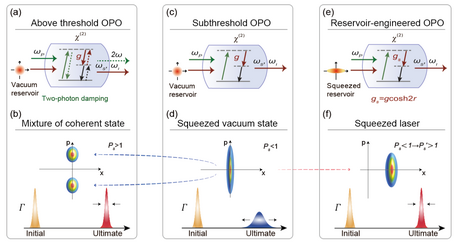 Physical mechanism of the parametric coupling with vacuum or squeezed vacuum reservoir. (a) Parametric down-conversion (PDC) in an above threshold OPO. (b) Mixture of two coherent states with coherence preservation and quantum characteristic deterioration. (c) PDC in a subthreshold OPO. (d) Squeezed vacuum state with quantum characteristic preservation and coherence deterioration. (e) PDC in a subthreshold OPO with squeezing vacuum reservoir. (f) Squeezed lasing with coherence and quantum characteristic preservation.

Carlos Sánchez
Quantum metrology through spectral measurements in quantum optics — 18:30-19:00
- A central challenge in quantum metrology from open quantum optical systems is to identify measurement strategies that optimally extract information encoded in the complex quantum state of emitted radiation. Different measurement strategies effectively access distinct temporal modes of the emitted field, and the resulting choice of mode can strongly impact the information available for parameter estimation. While a ubiquitous approach in quantum optics is to select frequency modes through spectral filtering, the metrological potential of this technique has not yet been systematically quantified. We develop a theoretical framework to assess this potential by modeling spectral detection as a cascaded quantum system, allowing us to reconstruct the full density matrix of frequency-filtered photonic modes and to compute their associated Fisher information. We show how this approach allows us to identify optimal filtering strategies for metrology, in terms of frequency selection, detector linewidth, and metrological gain accessible through multiphoton frequency-resolved correlations and mean-field engineering.
20:30 Dinner
Thursday 9 October (Day 2)
Morning Session
Sven Höfling
Towards photonic cluster state generation at the telecom wavelength — 9:00-9:30
- In recent years, it has been demonstrated that semiconductor quantum dots can act as deterministic sources of quantum light. An advanced demonstration is the generation of polarization-entangled photonic cluster states, a useful resource for quantum computing.[37][38] While this demonstration used an emission wavelength in the 900 nm range, many practical applications require a longer wavelength. For example, applications that involve silicon photonic quantum integrated circuits or optical fibers to minimize losses. For both, the wavelength of 1550 nm is well suitable.
- In this talk, I will present our recent progress towards demonstrating a cluster state generation protocol using telecom-emitting quantum dots. In particular, we use an InAs/InAlGaAs quantum dot incorporated in a circular Bragg grating (‘Bullseye’) microcavity. We will present spin initialization and readout experiments based on a confined hole, and describe the pulse sequence needed to implement cluster state generation. Finally, we will share recent three-photon correlation results on the path to obtaining a full tomography of the process.
Tim Thomay
Higher-order Fock states for sensing applications. — 9:30-10:00
- Quantum light offers groundbreaking opportunities in communication, computing, and sensing, forming the foundation of the emerging “Quantum Internet.” Most current applications rely on single photons and quantum entanglement to achieve quantum advantage. However, going beyond the single-photon regime, higher-order Fock states open entirely new avenues for quantum metrology, enhanced sensing protocols, and scalable quantum networks. A central challenge is their efficient detection, which is strongly affected by photon losses and imperfect measurement devices.
- This presentation will first introduce the key distinctions between single-photon quantum light and the unique properties of higher-order Fock states. I will then discuss approaches for generating such states from solid-state nanostructures and their integration into optical fibers for scalable, fiber-based quantum devices. Additionally, I will highlight our recent work applying machine learning techniques to optimize the detection of higher-order Fock states, showing how data-driven strategies can mitigate losses and noise. Finally, I will provide examples of how multiphoton states can unlock practical applications in quantum computing, precision sensing, and fundamental physics.[39]
Antonio Isaac Fernandez Dominguez
Preparation of quantum emitter states with nanophotonics tools — 10:00-10:30
- In this talk, I will discuss different nanophotonics-based strategies to generate tailored states of quantum emitters. First, I will explore the creation of highly entangled multiqubit states by inverse engineering of their photonic environment.[40][41] Next, I will address the preparation of topologically protected excitonic states in emitter chains that emulate a Su–Schrieffer–Heeger Hamiltonian (to appear in ACS Photonics). Finally, I will briefly examine the spatial dependence of photon correlations in pairs of quantum emitters placed near elementary nanophotonic structures, highlighting the conditions under which their suppression becomes independent of the internal state of the emitters themselve.[42]
Eduardo Zubizarreta Casalengua
Steering photons through energy and time — 10:30-11:00
- Frequency (energy) and time-resolved photon correlations are nowadays a well-established tool in quantum optics.[15] Nonetheless, for time-dependent situations, special emphasis must be placed on the role of time detection. For this purpose, we propose an efficient method to compute frequency-filtered and time-bin-integrated photon correlations, and then we link them to the photon-counting probabilities.[43] We show that photon statistics of pulsed Resonance Fluorescence emission can range from bunching to antibunching, depending on the photon frequencies and the pulse area. Then, we highlight the potential of time binning on photonic quantum states using linear optics elements and a periodic structure of less-than-one-photon pulses. In a Mach-Zehnder interferometer setup, we demonstrate how to generate few-photon states deterministically[44] and create temporal and spatial (modes) entanglement from this photon crystal. By adequately selecting the relevant frequencies and time windows, one could potentially select the number of photons in different time bins that lead to the desired entanglement of the state.
Coffee break
Post-Coffee Session
Zhiliang Yuan
From Two-Photon Nowhere to a Two-Photon Emitter — 11:20-11:50
- In a coherently driven two-level system, simultaneous two-photon emission is forbidden, yet strong two-photon correlations can still arise via quantum interference, as described by the pure-state model of resonance fluorescence and experimentally confirmed.[45][46] However, the achievable brightness in this regime is fundamentally limited. Motivated by this constraint, we demonstrate a natural two-photon emitter using a semiconductor quantum dot with degenerate biexciton–exciton transitions embedded in a Purcell-enhanced micropillar cavity. By exploiting dark-state biexciton loading and leveraging single-photon stimulated emission, we achieve a record two-photon fraction of 98.3%, marking a significant advance toward on-demand, solid- state multiphoton quantum light sources.
Carlos Antón Solanas
Superposition and entanglement with vacuum-one-photon states — 11:50-12:20
- A two-level system (such as a charged semiconductor quantum dot), excited under a pulsed resonant drive of area $\theta$, emits photon-number superposition states composed by vacuum and a single-photon in the form $\cos(\theta/2)\ket{0}+\sin(\theta/2)\ket{1}$.[47][48] Additionally, a sequential two-pulse excitation can generate photon-number encoded time-entangled states of the form ${1\over\sqrt2}(\ket{0_e0_l}+\ket{1_e1_l})$ or ${1\over\sqrt2}(\ket{1_e0_l}+\ket{0_e1_l})$, where the subindex e and l refer to early and late time-bins, respectively.[49][50] The expansion of this sequential excitation to a three-level system (such as one polarisation cascade of the biexciton-exciton decay) generates entanglement in time and energy,[51] with prospects to allow secure quantum communication protocols.[52]
- In this talk, I will revisit these works and will discuss ongoing experiments on ⑴ the photon-number emission from the Ramsey sequence and its connection to energy exchanges between a two-level system and the light field, and ⑵ the constrained metrology performance of photon-number encoded Fibonacci states and alternatives to reach Heisenberg scaling in metrology protocols.[53]
Sang Kyu Kim 

Deterministic control of photon-number probabilities via phase-controlled quantum interference — 12:20-12:40
- Deterministically tailoring optical Fock states beyond the single-photon level is crucial for boson sampling, loss-tolerant photonic qubits, and quantum-enhanced sensing, however has yet remained elusive. Here, we present a linear-optics protocol that converts a resonantly driven single-photon emitter into a deterministic generator of few-photon states.[44] Specifically, a phase-stabilized, path-unbalanced Mach-Zehnder interferometer combines vacuum—single-photon interference and Hong-Ou-Mandel effect. By tuning the control knobs, we observe a dynamic transition from antibunching to strong bunching in correlation measurements, shaping photon-number probabilities. With two indistinguishable emitters, this framework could be extended to generate deterministic NOON states and to filter single photons.
Alejandro González Tudela
Controlling propagating photons with chiral, multi-mode waveguide QED — 12:40-13:10
- Controlling propagating quantum states of light is essential for the development of photonic quantum technologies. In this talk, I will first review how qualitatively new photon-mediated interactions emerge when emitters or resonators couple to chiral, multi-mode waveguides.[54] I will then show how these interactions enable the implementation of controlled photon-photon phase gates using only two-level systems.[55] In both cases, I will discuss potential implementations in the microwave using circuit QED setups.
Lunch
Afternoon Session
Vincenzo D'Ambrosio
Tailoring spatial correlations with structured light — 14:30-15:00
- Photon correlations represent a central resource in quantum optics, with applications ranging from quantum information protocols to sensing. Engineering such correlations is often challenging, especially in multi-particle scenarios. Structured light forms another hallmark of photonics, achieved by manipulating the degrees of freedom of light, and enables a multitude of applications in both classical and quantum regimes. Here, we combine these concepts and demonstrate a simple and robust scheme to tailor photon correlations directly in the transverse plane. The method relies on locally tuning the distinguishability of photon pairs through spatially structured polarization in a quantum interference setup.[56][57] Our approach offers an easy extension to multiphoton regimes and provides opportunities for high-dimensional quantum information transfer, with potential applications in quantum communication and imaging.
Alexandros Spiliotis
Enhancing Spatial Photonic Ising Machines with quantum correlations: applications in the one- and multi-photon regimes — 15:00-15:30
- Spatial Photonic Ising Machines (SPIMs)[58] are optical computing systems that use spatial light modulators (SLM) to encode and solve complex optimization problems mapped onto the Ising model. In this architecture, the spin state and system interactions are encoded directly on the SLM pixels, which enables inherent parallel storage and processing of the spin state. This creates a flexible and low-cost platform that allows the fast, parallel calculation of the Hamiltonian energy of highly scalable systems via a direct optical Fourier transform. The fundamental limitations in scalability of such systems are a) wavefront distortions by the various system optics, and b) the shot-noise limit, both inherent in classical implementations with laser illumination. Recently, our group demonstrated a method for effective optical aberration compensation and amplitude flattening, which paves the way for arbitrary system size scalability of the SPIM,[59] thus tackling the former limitation.
- In this talk, we will discuss how quantum light, in the one-photon and multi-photon regimes can be harnessed to overcome the shot-noise limitation and further enhance the computational performance of the SPIM. In the one-photon regime, we illuminate the SPIM with a bright spontaneous parametric down- conversion (SPDC) source to suppress intensity fluctuations. Such sources can also be utilized in the two-photon regime, as a means to compensate the system aberrations;[60] and generate stronger observables by harnessing spatial correlations of structured light, such as vortex beams. Combined with the compensation of aberrations and novel encoding methods recently developed by our group, these methods will allow significantly larger spin systems to be solved by the SPIM.
Natalia Armaou
Spatial correlations of opposite OAM states of light — 15:30-15:50
- The exploration of spatial correlations among bosons is of great interest, both for understanding fundamental quantum phenomena and for their relevance to applications such as boson sampling and quantum information. In this work, we experimentally investigate the interference of opposite Laguerre–Gaussian vortex states of light and their resulting spatial distributions. Otherwise indistinguishable pairs of down-converted photons in opposite $\operatorname{LG}_0^{\pm l}$ modes are prepared and recombined in a Hong–Ou–Mandel (HOM) interferometer. At zero delay, we observe an enhanced probability for photons to occupy specific relative angular positions around the ring, with maxima where the vortices are in phase and minima where they are out of phase. Consequently, the photons form bunching and antibunching angular regions in random directions. Averaging over many realizations, a ring-shaped distribution is restored.[6] Scaling to larger photon-number Fock states, the multiphoton correlations are expected to persist. In this regime, it is particularly intriguing to examine different sources of light; thermal, coherent, and randomly phased coherent states, each expected to display distinct phenomenology.
Fabrice Laussy
Liquid time and time liquids — 15:50-16:20
- The basic quantum-optical emitter—the two-level system—is already much more complicated than one could reasonably expect, and to this day, its thorough characterization remains to be completed.[22] Here, I will jump to the case of the $N$-level system, and survey the amazing phenomenology that immediately shouts out from this simplest extension of the brick of quantum optics. A first surprise is that the $N$-level system, not the two-level one, is the most suitable to implement perfect single-photon sources.[61] Furthemore, a good single-photon source acquires features that differ considerably from those usually wanted for that purpose. For instance, instead of merely suppressing two-photon coincidences at $\tau=0$, a good single-photon emitter is one that develops long-time oscillations as a result of self-organizing its photon streams to all orders in photon counting, differing from the basic case in a way similar to how a liquid differs from a gas.[62] This calls for revisiting our understanding of single-photon sources, and raise fascinating questions on how they relate, in time, to exotic phase of matters.[63] I will also describe how such a picture extends into multiphotonics,[64][20] and how one could observe such effects experimentally.[65]
Closing (by Carlos Sánchez)
Goodbye coffee & Merienda
Participants depart
Friday 10 October (After)

Prof. S. Reynaud will also give an INC (Instituto Nicolás Cabrera) Colloquium, «Vacuum fluctuations and Casimir forces», at 12:00 in the seminar room of Module 4, Faculty of Sciences (01.04.SS.500).
All details can be found in this page.
Q&A(bstracts)
At this occasion, we shall try to revive an old format of archiving Scientific debates: instead of publishing proceedings, we will publish the abstract and the (edited) Questions & Answers sessions, which contains information nowhere else to be found.
One picture is worth a thousand words

For the Multiphotonics (2024), each participant contributed a formula, meaningful and/or inspiring for them, characteristic of their contribution to the field or merely illustrating their talk. Interestingly, there was no degeneracy: Rempe provided the Jaynes-Cummings Hamiltonian, someone went for the mere harmonic oscillator (but wasn't Dirac saying it was enough to understand this?), I (Fabrice) offered the dissipative Jaynes-Cumming ladder formula, which I still haven't found in any publication earlier to mine,[66] Eduardo provided the two-photon spectrum of resonance fluorescence, ${(\omega_1+\omega_1^2+\omega_2+\omega_2^2)^2\over(1+\omega_1)^2(1+\omega_2)^2(\omega_1+\omega_2)^2}$ which produces the logo of the meeting (the blue circle in the numerator, the reddish glowing triangle in the denominator). A pretty formula indeed.
For this edition, we'd like to try the same thing but with a figure instead of a formula. This could be a graph, a density plot, the sketch of a concept (artistic or scientific), a diagram, the setup of an experiment, etc., with the same intent of providing a picture—call that a vision if you like—to illustrate the participants' understanding of the topic, ideally with a connection to their talk, even if a remote one. Out of this medley of visual cues to what light-matter interactions is about, we will build the logo of the 2025 meeting.
References
- ↑ The resonance fluorescence cascade of a laser-excited two-level atom. S. Reynaud in Adv. Cont. Disc. Mod. 2023:15 (2023).
- ↑ Signatures of two-photon pulses from a quantum two-level system. K. Fischer, L. Hanschke, J. Wierzbowski, T. Simmet, C. Dory, J. Finley, J. Vučković and K. Müller in Nature Phys. 13:649 (2017).
- ↑ Quantum dot single-photon sources with ultra-low multi-photon probability. L. Hanschke, K. A. Fischer, S. Appel, D. Lukin, J. Wierzbowski, S. Sun, R. Trivedi, J. Vučković, J. J. Finley and K. Müller in npj Quantum Inf. 4:43 (2018).
- ↑ Stimulated Generation of Indistinguishable Single Photons from a Quantum Ladder System. F. Sbresny, L. Hanschke, E. Schöll, W. Rauhaus, B. Scaparra, K. Boos, E. Zubizarreta Casalengua, H. Riedl, E. del Valle, J. J. Finley, K. D. Jöns and K. Müller in Phys. Rev. Lett. 128:093603 (2022).
- ↑
 Selective filtering of multi-photon events from a single-photon emitter. F. Sbresny, C. Calcagno, S. K. Kim, K. Boos, W. Rauhaus, F. Bopp, H. Riedl, J. J. Finley, E. Zubizarreta Casalengua and K. Müller in arXiv:2506.22378 (2025).
- ↑ 6.0 6.1 Spatial correlations of vortex quantum states. E. Zubizarreta Casalengua and F. P. Laussy in arXiv:2402.01627 (2024).
- ↑ Excitation with quantum light. II. Exciting a two-level system. J. C. López Carreño, C. Sánchez Muñoz, E. del Valle and F.P. Laussy in Phys. Rev. A 94:063826 (2016).
- ↑ Joint subnatural-linewidth and single-photon emission from resonance fluorescence. J. C. López Carreño, E. Zubizarreta Casalengua, F.P. Laussy and E. del Valle in Quantum Sci. Technol. 3:045001 (2018).
- ↑ Cascaded Single Photons from Pulsed Quantum Excitation. J. C. López Carreño in arXiv:2411.16539 (2024).
- ↑ Non-classical excitation of a solid-state quantum emitter. L. M. Hansen, F. Giorgino, L. Jehle, L. Carosini, J. C. López Carreño, I. Arrazola, P. Walther and J. C. Loredo in arXiv:2407.20936 (2024).
- ↑ Near-optimal single-photon sources in the solid state. N. Somaschi, V. Giesz, L. De Santis, J. C. Loredo, M. P. Almeida, G. Hornecker, S. L. Portalupi, T. Grange, C. Antón, J. Demory, C. Gómez, I. Sagnes, N. D. Lanzillotti-Kimura, A. Lemaître, A. Auffèves, A. G. White, L. Lanco and P. Senellart in Nature Photon. 10:340 (2016).
- ↑ A bright and fast source of coherent single photons. N. Tomm, A. Javadi, N. Antoniadis, D. Najer, M. Löbl, A. Korsch, R. Schott, S. Valentin, A. Wieck, A. Ludwig and R. Warburton in Nature Nanotech. 16:399 (2021).
- ↑ Stochastic Approach to the Quantum Noise of a Single-Emitter Nanolaser. M. Bundgaard-Nielsen, E. V. Denning, M. Saldutti and J. Mork in Phys. Rev. Lett. 130:253801 (2023).
- ↑ Simple yet Accurate Stochastic Approach to the Quantum Phase Noise of Nanolasers. M. Bundgaard-Nielsen, M. Saldutti, B. F. Gotzsche, E. Grovn and J. Mork in Phys. Rev. Lett. 134:213804 (2025).
- ↑ 15.0 15.1 15.2 Theory of Frequency-Filtered and Time-Resolved $N$-Photon Correlations. E. del Valle, A. González-Tudela, F. P. Laussy, C. Tejedor and M. J. Hartmann in Phys. Rev. Lett. 109:183601 (2012).

- ↑ Distilling one, two and entangled pairs of photons from a quantum dot with cavity QED effects and spectral filtering. E. del Valle in New J. Phys. 15:025019 (2013).
- ↑ La fluorescence de résonance: étude par la méthode de l'atome habillé. S. Reynaud in Annales de Physique 8:351 (1983).
- ↑ Power Spectrum of Light Scattered by Two-Level Systems. B. R. Mollow in Phys. Rev. 188:1969 (1969).
- ↑ Two-photon spectra of quantum emitters. A. González-Tudela, F. P. Laussy, C. Tejedor, M. J Hartmann and E. del Valle in New J. Phys. 15:033036 (2013).
- ↑ 20.0 20.1 Emitters of $N$-photon bundles. C. Sánchez Muñoz, E. del Valle, A. González Tudela, K. Müller, S. Lichtmannecker, M. Kaniber, C. Tejedor, J.J. Finley and F.P. Laussy in Nature Photon. 8:550 (2014).
- ↑ Conventional and Unconventional Photon statistics. E. Zubizarreta Casalengua, J. C. López Carreño, F. P. Laussy and E. del Valle in Laser Photon. Rev. 14:1900279 (2020).
- ↑ 22.0 22.1 Two photons everywhere. E. Zubizarreta Casalengua, F. P. Laussy and E. del Valle in Phil. Trans. R. Soc. A 382:20230315 (2024).
- ↑ Two-color photon correlations of the light scattered by a quantum dot. M. Peiris, B. Petrak, K. Konthasinghe, Y. Yu, Z. C. Niu and A. Muller in Phys. Rev. B 91:195125 (2015).
- ↑ Roadmap on quantum light spectroscopy. S. Mukamel, M. Freyberger, W. Schleich, M. Bellini, A. Zavatta, G. Leuchs, C. Silberhorn, R.W. Boyd, L. Lorenzo Sánchez-Soto, A. Stefanov, M. Barbieri, A. Paterova, L. Krivitsky, S. Shwartz, K Tamasaku, K. Dorfman, F. Schlawin, V. Sandoghdar, M. Raymer, A. Marcus, O. Varnavski, T. Goodson III, Z.-Y. Zhou, B.-S. Shi, S. Asban, M. Scully, G. Agarwal, T Peng, A.V. Sokolov, Z.-D. Zhang, M. Suhail Zubairy, I.A. Vartanyants, E. del Valle and F. Laussy in J. Opt. B 53:072002 (2020).
- ↑ Correlating photons using the collective nonlinear response of atoms weakly coupled to an optical mode. A. S. Prasad, J. Hinney, S. Mahmoodian, K. Hammerer, S. Rind, P. Schneeweiss, A. S. Sørensen, J. Volz and A. Rauschenbeute in Nature Photon. 14:719 (2020).
- ↑ Tailoring Photon Statistics with an Atom-Based Two-Photon Interferometer. M. Cordier, M. Schemmer, P. Schneeweiss, J. Volz and A. Rauschenbeutel in Phys. Rev. Lett. 131:183601 (2023).
- ↑ Few-Mode Field Quantization of Arbitrary Electromagnetic Spectral Densities. I. Medina, F. García-Vidal, A. Fernández-Domínguez and J. Feist in Phys. Rev. Lett. 126:093601 (2021).
- ↑ Few-mode field quantization for multiple emitters. M. Sánchez-Barquilla, F. García-Vidal, A. Fernández-Domínguez and J. Feist in Nanophot. 11:4363 (2022).
- ↑ Spatially Resolved Photon Statistics of General Nanophotonic Systems. M. Lednev, D. Fernández de la Pradilla, F. Lindel, E. Moreno, F. García-Vidal and J. Feist in Phys. Rev. X Quantum 6:020361 (2025).
- ↑ There is no ultrastrong coupling with photons. D. F. de la Pradilla, E. Moreno and J. Feist in arXiv:2508.00702 (2025).
- ↑ Unlocking multiphoton emission from a single-photon source through mean-field engineering. S. K. Kim, E. Zubizarreta Casalengua, K. Boos, F. Sbresny, C. Calcagno, H. Riedl, J. J. Finley, C. Antón-Solanas, F. P. Laussy, K. M"uller, L. Hanschke and E. del Valle in arXiv:2411.10441 (2024).
- ↑ Two-Photon Resonance Fluorescence in a Three-Level Ladder-Type Atom. J. Ngaha, S. Parkins and H. J. Carmichael in arXiv:2503.16772 (2025).
- ↑ Multimode array filtering of resonance fluorescence. J. Ngaha, S. Parkins and H. Carmichael in Phys. Rev. A 110:023719 (2024).
- ↑ Quantum-enhanced laser phase noise filter. R. Li, N. Jiao, B. An, Y. Wang, S. Shi, L. Tian, W. Li and Y. Zheng in arXiv:2507.05771 (2025).
- ↑ Bright squeezed light in the kilohertz frequency band. R. Li, B. An, N. Jiao, J. Liu, L. Chen, Y. Wang and Y. Zheng in arXiv:2504.00627 (2025).
- ↑ Reservoir-Engineered Squeezed Lasing through the Parametric Coupling. Y. Tian, Y. Wang, W. Wang, X. Sun, Y. Li, S. Shi, L. Tian and Y. Zheng in Phys. Rev. Lett. 134:243803 (2025).
- ↑ Deterministic generation of a cluster state of entangled photons. I. Schwartz, D. Cogane, R. Schmidgall, Y. Don, L. Gantz, O. Kenneth, N. H. Lindner and D. Gershoni in Science 354:434 (2016).
- ↑ Deterministic generation of indistinguishable photons in a cluster state. D. Cogan, Z.-E. Su, O. Kenneth and D. Gershoni in Nature Photon. 17:324 (2023).
- ↑ Statistical model for quantum spin and photon number states. S. Powers, G. Xu, H. Fotso, T. Thomay and D. Stojkovic in Phys. Rev. A 111:012217 (2025).
- ↑ Inverse-designed dielectric cloaks for entanglement generation. A. Miguel-Torcal, J. Abad-Arredondo, F. J. García-Vidal and A. I. Fernández-Domínguez in Nanophot. 11:4387 (2022).
- ↑ Multiqubit quantum state preparation enabled by topology optimization. A. Miguel-Torcal, A. González-Tudela, F. J. García-Vidal and A. I. Fernández-Domínguez in Optica Q. 2:371 (2024).
- ↑ Geometric antibunching and directional shaping of photon anticorrelations. B. Durá-Azorín, A. Manjavacas and A. I. Fernández-Domínguez in Phys. Rev. Res. 7:023178 (2025).
- ↑ Spectral correlations of dynamical Resonance Fluorescence. S. B. Feijóo, E. Zubizarreta Casalengua, K. Müller and K. D. Jöns in arXiv:2504.05242 (2025).
- ↑ 44.0 44.1 Deterministic Control of Photon-Number Probabilities via Phase-Controlled Quantum Interference. S. K. Kim, E. Zubizarreta Casalengua, Y. Sim, F. Sbresny, C. Calcagno, H. Riedl, J. J. Finley, E. del Valle, C. Antón-Solanas, K. Müller and L. Hanschke in arXiv:2508.15352 (2025).
- ↑ Coherence in resonance fluorescence. X. Wang, G. Huang, M. Li, Y. Wang, L. Liu, B. Wu, H. Liu, H. Ni, Z. Niu, W. Ji, R. Jiao, H. Yin and Z. Yuan in Nature Comm. 16:6453 (2025).
- ↑ Two-photon interference between mutually-detuned resonance fluorescence signals scattered off a semiconductor quantum dot. G. Huang, J. Wang, Z. Zeng, H. Liu, L. Liu, W. Ji, B. Wu, H. Ni, Z. Niu, R. Jiao, D. G. Marangon and Z. Yuan in arXiv:2501.16939 (2025).
- ↑ Generation of non-classical light in a photon-number superposition. J. C. Loredo, C. Antón, B. Reznychenko, P. Hilaire, A. Harouri, C. Millet, H. Ollivier, N. Somaschi, L. De Santis, A. Lemaître, I. Sagnes, L. Lanco, A. Aufféves, O. Krebs and P. Senellart in Nature Photon. 13:803 (2019).
- ↑ Controlling the photon number coherence of solid-state quantum light sources for quantum cryptography. Y. Karli, D. A. Vajner, F. Kappe, P. C. A. Hagen, L. M. Hansen, R. Schwarz, T. K. Bracht, C. Schimpf, S. F. C. d. Silva, P. Walther, A. Rastelli, V. M. Axt, J. C. Loredo, V. Remesh, T. Heindel, D. E. Reiter and G. Weihs in npj Quantum Inf. 10:17 (2024).
- ↑ Photon-number entanglement generated by sequential excitation of a two-level atom. S. C. Wein, J. C. Loredo, M. Maffei, P. Hilaire, A. Harouri, N. Somaschi, A. Lemaître, I. Sagnes, L. Lanco, O. Krebs, A. Auffèves, C. Simon, P. Senellart and C. Antón-Solanas in Nature Photon. 16:374 (2022).
- ↑ How to administer an antidote to Schrödinger’s cat. J. Alvarez, M. IJspeert, O. Barter, B. Yuen, T. D. Barrett, D. Stuart, J. Dilley, A. Holleczek and A. Kuhn in J. Phys. B.: At. Mol. Phys. 55:054001 (2022).
- ↑ Exploring photon-number-encoded high-dimensional entanglement from a sequentially excited quantum three-level system. D. A. Vajner, N. D. Kewitz, M. v. Helversen, S. C. Wein, Y. Karli, F. Kappe, V. Remesh, S. F. C. d. Silva, A. Rastelli, G. Weihs, C. Anton-Solanas and T. Heindel in Optica Q. 3:99 (2025).
- ↑ Multipartite entanglement encoded in the photon-number basis by sequential excitation of a three-level system. A. C. Santos, C. Schneider, R. Bachelard, A. Predojevic and C. Antón-Solanas in Opt. Lett. 48:6332 (2023).
- ↑ Quantum metrology with one-dimensional superradiant photonic states. V. Paulisch, M. Perarnau-Llobet, A. González-Tudela and J. I. Cirac in Phys. Rev. A 99:043807 (2019).
- ↑ Topological, multi-mode amplification induced by non-reciprocal, long-range dissipative couplings. C. Vega, A. M. d. l. Heras, D. Porras and A. González-Tudela in arXiv:2405.10176 (2024).
- ↑ Passive Photonic CZ Gate with Two-Level Emitters in Chiral Multimode Waveguide QED. T. Levy-Yeyati, C. Vega, T. Ramos and A. González-Tudela in Phys. Rev. X Quantum 6:010342 (2025).
- ↑ Engineering quantum states from a spatially structured quantum eraser. C. Schiano, B. Sephton, R. Aiello, F. Graffitti, N. Lal, A. Chiuri, S. Santoro, L. S. Amato, L. Marrucci, C. d. Lisio and V. D’Ambrosio in Science Advances 10:eadm9278 (2024).
- ↑ Tailoring spatial correlations with quantum interference. C. Schiano, B. Sephton, E. Darsheshdar, L. Marrucci, C. de Lisio and V. D'Ambrosio in arXiv:2509.04725 (2025).
- ↑ Large-Scale Photonic Ising Machine by Spatial Light Modulation. D. Pierangeli, G. Marcucci and C. Conti in Phys. Rev. Lett. 122:213902 (2019).
- ↑ Optimization of Spatial Photonic Ising Machine Enabling Full Scalability, P. Karavelas et al., in preparation.
- ↑ Adaptive optical imaging with entangled photons. P. Cameron, B. Courme, C. Vernière, R. Pandya, D. Faccio and H. Defienne in Science 383:1142 (2024).
- ↑ Perfect single-photon sources. S. Khalid and F. P. Laussy in Sci. Rep. 14:2684 (2024).
- ↑ Photon liquefaction in time. E. Zubizarreta Casalengua, E. del Valle and F. P. Laussy in APL Quant. 1:026117 (2024).
- ↑ Crystals in Time. F. Wilczek in Sci. Am. 32:28 (2019).
- ↑ Correlations in circular quantum cascades. M. A. Palomo Marcos, E. Zubizarreta Casalengua, E. del Valle and F. P. Laussy in Phys. Rev. A 111:023704 (2025).
- ↑ Correlations in a three-level system, A. Barreto Padrón, E. del Valle and F. P. Laussy, unpublished.
- ↑ Climbing the Jaynes-Cummings ladder by photon counting. F. P. Laussy, E. del Valle, M. Schrapp, A. Laucht and J. J. Finley in J. Nanophoton. 6:061803 (2012).